Saturday, 30 May 2015

Abiezer Coppe

Another oddball wandering around in the English Civil war is Abiezer Coppe, the infamous Ranter prophet.

Reading about the Ranters today it is hard to believe such lunatics existed as long ago as the 17th century. They were extreme Antinomian anarchists, they believed that for the truly 'saved' there was no obligation to follow the laws of God or Man, that sin existed only in the imagination of men who wished to restrain God's spirit, not exalt it and that there was no such thing as private property for all belonged to God alone, and was free to use by the fiathful..

They drank and smoked tobacco immoderately (the nearest thing to dope they could get in 17th century England presumably), indulged in 'love feasts' full of serious drinking and casual sex and ran off without paying the bill, they allegedly stole, lied and cheated and were generally complete arseholes.

But there was a manic mysticism behind it all, a genuine feeling they had transcended the mundane Christianity of the Churches to become greater than Jesus himself, their personal wants one with those of the Godhead. Some even burned the Bible to demonstrate they had no need of it, and went around naked to show they abandoned absolutely all earthly goods.

Needless to say they got in serious trouble and the whole mad sect dissolved during the 1660's, variously converting to less deranged (but still pretty mystical) sects like the Quakers, ending up in jail or transported to the colonies, running off the the colonies before they got transported, and probably drinking, smoking and fornicating themselves to death.

They never had leaders, the whole concept was against everything they lounged louchely in the corner of a pub for, but one of the most famous today was Abiezer, as he left us some quite remarkable and pretty incomprehensible writings, most notably 'The Fiery Flying Roll' published in 1650.

As of 1642 Coppe is a young man of 23, not long 'graduated' from Oxford University (he kind of abandoned studying Divinity under such conventional church-bound bores, kind of got thrown out for being the worst kind of slack, argumentative and drunken student imaginable). He is making his way round England meeting the many extreme dissenting preachers of the many sub-sects and political movements beginning to emerge as the Civil War loosens and occasionally preaching his own brand of kooky salvation on street corners, crowds of drunks in taverns and at the odd Seeker meeting house and radical Congregationalist church.

This character was created using Marc Gacy's classess LotFP system from Undercroft #4, available from Daniel Sell at http://whatwouldconando.blogspot.co.uk/.

Abiezer Coppe, Laurence Clarkson, Prudence Hever and Sally Price live it up at the Lamb and Flag in Colchester


Abiezer Coppe

Age 23
Alignment: Neutral Cavalier
Religion: Ranter
Level 4

Cha 13 (+1) Con 15 (+1) Dex 11 Int 13 (+1) Wis 17 (+2) Str 8 (-1)
Saves: Pa: 11 Po: 11 BW: 15 MD: 13 Ma: 14
Sills: Stealth 3 Bushcraft 2 Climbing 2

Att + 1
Can cast Cleric spells at level 2
Languages: English, Latin

AC 13
HP 19

Buff Coat with 'poacher's pockets'
Felt hat
Tuck (d6 dam -1 to hit vs AC 15+)
Dagger
Purse with 3s 17d
Several rabbit snares, 1 in 3 chance of a rabbit
Someone else's mutton pie
Bottle of cheap wine
Pewter beer mug with engraving 'Property of Merton College'
A bent spoon, gift of a Jewish mystic he met while pissed as a newt in a pub in London
Hatchet
Heavily annotated Bible, with many crossings out, marginal comments like 'rubbish', 'Ezekiel was a dunce' and 'must use in next sermon'
Hastily scrawled sermon on back of a tavern bill of fare with numerous beer stains, lots of exclamation marks and underlinings of bits to be delivered in stentorian shout
Pipe
Pouch of tobacco
Twist of paper with willow bark for use as hangover cure
Letter from Laurence Clarkson, a fellow Ranter; contents partly theological, partly a good pub guide to the taverns of Essex
Key to the back door of the home of Mrs Prudence Hever of Colchester, an advocate of Free Love

Spells:
Level 1: Purify Food and Drink, Sanctuary

Abiezer is a tall, thin young man, usually sporting a couple days growth of beard and long, somewhat unkempt, hair, a shirt with a few small holes from stray wisps of burning tobacco and a hard used leather coat with patches on the elbows and voluminous pockets. There is little visually to distinguish him from any number of wandering labourers and runaway apprentices, such vagabonds are ten a penny, and he will often be found in the company of such.

He is better spoken than most (though he can put on a 'Mockney' fake working class accent when trying to pass unnoticed), and has a slightly mad twinkle in his eye and a tendency to use long words that don't entirely pass as proper English. His habit of addressing people as 'Fellow Creature' will suggest that he is some variety of religious oddball, and he never raises his hat to people of greater social status, a bit of casual rudeness that is a sure mark of a Leveller.

He may be met almost anywhere, but hiding in the woods from the law, preaching on a street corner with his pipe hanging out of his mouth and a mug of ale in his hand, and stuck in the town stocks for a day for being out of order or skipping church are all likely possibilities.

He stays in inns when he can (and leaves without paying when he can get away with it), but is also used to living rough. There are sympathisers all over the place - he is a frequent lodger at John Pordage's house when he is London (Pordage is an astrologer and pretty eccentric in his own right), and knows John Tradescant, Elias Ashmole and John Lilburne in that city. His uncle Tobias runs a printing press and a newspaper in Boston in Lincolnshire, and Abiezer sometimes wanders up that way. 

His current project is the formulation of a doctrine that will confound the most flinty Presbyterian busybody and make them realise that salvation through being a judgemental nosebleed and trying to get all to conform to their rules is against God's will as expressed through the desires of ordinary mortal men, not a path to salvation. He is also concerned about goings on in Essex - he took part in the looting of suspected Catholic gentlemen's houses there, but is concerned that the Puritan mobs have taken to witch-hunting as well. He is plotting the rescue of accused witches, taking the view that they are closer to God that many of their hide-bound accusers and are mostly innocents picked on for their difference and petty village squabbles.

Not Abiezer Coppe, just some other scruffy ranting loon

Monday, 25 May 2015

Rules I use

I use a few house rules for LotFP, not very consistently unfortunately, so for my benefit if no one elses I will try and codify what they are, and try and explain why.

Surprise

In an encounter where one side has quite definitely 'got the drop' on the other surprise is automatic and lasts one round. 

Unsuspecting party in a boat floating through apparently uninhabited marsh gets volley of arrows from a prepared ambush, a round of 'wtf, argh, where's my musket?' kerfuffle is fair enough.

In situations where one or both sides don't know what is going on, but are expecting something the whole party are surprised on a 1-2.

Party A sploshes through the swamps, party B knows they are out there thanks to successful listen rolls but don't know where. When they meet party A may be surprised, B won't be.

Initiative

PCs make an individual roll with Dex bonus, monsters get a roll per group. If there is a tie PCs get the benefit of the doubt for being protagonists and go first (they get precious few other breaks and saves time faffing with on the fly Dex rolls).

If you use a special action like Press or Parry the AC penalty or bonus lasts until your initiative tick next round.

Fumbles and Criticals

On a natural 1 you fumble and on a natural 20 you crit. I use the Compleat Arduin fumble and critical tables, except for firearms where I have my own table. Crits do normal weapon damage, but the special effects add further penalties and may kill outright.

Fancy combat moves

I am a great fan of the DCC feat dice and RQ6 combat effects, gets the players thinking about more than just the thud, bang, wallop of melee and how to get the upper hand. For LotFP any character may try this - roll a second d20 add your combat bonus, subtract the enemies and if you get 17+ you have pulled some fancy manouvre; blinding, tripping, pushing back, blocking etc. Opponents may get a save or characteristic roll to avoid it, if appropriate.

Damage and Death

Not been very consistent about this but will follow this procedure...

If you are down to below 0 HP you are not automatically dead, but you roll on the Crit Table to see what horrible injury has happened to you to put you down; this may be terminal, like being shot in the head, and may leave you with a permanent disability like missing fingers, limbs, ears, face mashed in and scarred etc. .

If you are not dead yet, your friends may save you. Save vs Paralysis with a modifier of how many HP you are below 0; make it, you live, fail, well, that's it...

Roll your Con or under; if you fail you permanently lose 1d3 points on STR, DEX or CON rolled randomly due to scarring.

You remain on negative HP, and if not outright unconscious, you will able to do nothing until healing has brought you back to positive HP; if by some miracle you survive a boulder being dropped on you from a great height, expect to spend a week in bed getting over it.

PCs will become increasingly battered and scarred, limping, eye-patched and hook-handed. If they wish to quit this adventuring malarkey as too much like hard work, they are free to.

Being beaten to a pulp and living to tell the tale in this way earns a +d100 XP bonus, for what it is worth. The experience isn't fun, but it will teach you what not to do next time.

Healing

Effects like broken arms, sprained ankles, dislocated shoulders etc, are healed when you reach full HP again.

A Cure Serious Wounds will remove such effects even if it does not restore the recipient to full HP, and can be used to reattach missing limbs and digits (if they have been recovered from the site of the carnage) and restore damaged eyes and ears if cast within a week.

Heal will induce the regrowth of lost limbs at a rate of 1d10% of lost part per week.

Clerical Services

The various churches and denominations are more than willing to provide healing magic to those who make donations, and may possibly be persuaded to do it for free for co-religionists who are obviously fighting the good fight. Basic costs are below, though these are subject to a wide variety of circumstantial modifiers, and the higher level ones will only be available from a very few preachers who will require a long journey to find. The Archbishop of Canterbury is himself only 11th level, most typical parish priests and Puritan preachers are level 1-5 (roll 2d4-3, min 1).

(using the 12 pence = 1 shilling, 20 shillings = 1 pound system of pre-decimal England)

Level 1
Bless - 1s plus 6d per level of cleric
Cure Light Wounds - £1
Detect Evil - £1

Level 2
Augury - £3
Delay Poison - £2

Level 3
Cure Disease - £10
Remove Curse - £50

Level 4
Cure Serious Wounds - £3 10s
Divination - £10 + £1 per caster level
Neutralize Poison - £10

Level 5
Commune - £150
Cure Critical Wounds - £6

Level 6
Heal - £100

For the devout Clerical scrolls may be sold. These may also take the from of specially blessed holy symbols which will provide one use of a spell when a specific prayer or verse from the Bible is spoken, rosaries or candles (for Catholics), blessed printed tracts with woodcuts (for Puritans) or other form of religious paraphenalia. The cost is level of spell x £30, far from cheap!

Magical Services

Witches, alchemists and other such dubious riff-raff can be found all over the place, though the devout frown on their odious practices and it may take a bit of careful inquiry to locate them and persuade them to help. Astrologers practice openly, and there are 'scholars' who will offer advice and opinions on magical matters.Some common services on offer are below, but any given magic user will only know some of the spells and have some of the equipment.

Spells may be bought from a few magicians. A magic users livelihood and reputation rests on his unique stock of arcane knowledge and most like to keep what they know secret for fear of setting up rivals. Basic cost is £25 per level of spell, including the cost of transcription into the recipients spell book. It is often cheaper to research it yourself.

Level 1
Potion of Charm Person - a perennial favourite, these 'love potions' may also take the form of charms or rituals to be used to attract the target. Cost £20.
Identify - £10 if the magic user has a suitable lab, usually only available to wealthy apothecaries and scholars.
Detect Magic - £1 10s

Level 2
Light, Continual - 5s (note that these only last one day from time of purchase)
Magic Mouth - £10

Level 3
Dispel Magic - £10 plus expenses if travel required to magical site


Sunday, 10 May 2015

Sir Kenelm Digby

Sir Kenelm Digby was the real life analogue of a D&D character. A diplomat, natural philosopher and intellectual, he also managed to be a soldier, duellist and of course, was an egotistical braggart and bighead with it. 

As of 1642 he is in England after a sojourn in France to help King Charles put down those argumentative Parliamentary rebels (and get away from the relatives of the French aristocrat Mont Le Ros, who he killed in a duel). The King has sent him to investigate alarming reports of an outbreak of witchcraft and demons in the eastern counties of the country, rife with rebellion, the Ague and Puritanism, Quite possibly someone at court wants rid of the argumentative little twit, but he has thrown himself into the task with his customary brio, trusting that his natural panache and verve will see him win yet more plaudits and material for another book.

This character was created using Marc Gacy's classess LotFP system from Undercroft #4, available from Daniel Sell at http://whatwouldconando.blogspot.co.uk/.


Sir Kenelm Digby 

Age 39
Alignment: Royalist Cavalier 
Religion: Catholic
Level 9

Cha 16 (+2) Con 11 Dex 9 Int 16 (+2) Wis 7 (-1) Str 12
Att + 4 Can use Defend and Press
Can cast magic user spells while heavily encumbered
Magic User spell-casting at level 3 (2x 1st level, 1 x 2nd)
Languages: English, Latin, French, Italian

AC 15
HP 34

Pikeman's breastplate
Buff Coat
Cavalier hat
Sword with basket hilt
Flintlock pisttol
Powder horn
Pouch of 20 balls
Locket with miniature of a lady (worth £5 (gp))
Wedding ring
Signet ring
Safe investments worth £1000 (gp)
20 doses of his patent 'Weapon Salve'
10 copies of his pamphlet on Weapon Salve
A copy of 'Conference with a Lady about Choice of a Religion'
A commonplace book, mainly full of recipes for fancy meads
Letters from Thomas Hobbes on his evolving political theory of The Leviathan
Fine cavalry horse
Saddle and saddlebags

Retainers: 
Phillippe Fabrice, Servant

Spellbook
Level 1: Read Magic, Detect Magic, Unseen Servant, Magic Missile, Light, Charm Person, Magic Aura
Level 2: ESP, Forget, Detect Invisible 


Sir Kenelm's father, Everard, was part of the Gunpowder plot of 1606 and was hung, drawn and quartered. Sir Kenelm loudly proclaims his loyalty to the Crown and decries his father's foolishness in being led astray by Robert Catesby, Guy Fawkes and those other wretches. He is a Catholic, but outside the reasonably Catholic friendly court (and especially in the lands of the Eastern Association) he will keep it very quiet; he is an argumentative type though, so he might be goaded into defending his faith, quoting his own work of Catholic apologetics Conference with a Lady about Choice of a Religion.

The locket has a miniature of his late wife Venetia, if he is playing for sympathy and acting the respectable gent, otherwise it is Marie de Medici, Princess of Florence and also Queen of France at the time he knew her, if he is playing the man's man and cavalier. She, he claims, pursued him, but generally he only spreads this about when in England of the Netherlands;  in France it recently got him into a duel which he only won by Magic Missiling his opponent, a terrible breach of etiquette.

He is wealthy and still owns lands in Buckinghamshire and owns glass factories in Staffordshire and in Picardy in France where bottles of his own patent design of wine bottle are made, which provide a good income. He was also granted the monopoly of selling sealing wax in Wales and on the Welsh borders which was pretty lucrative and still theoretically holds the monopoly on all trade with the coast of Guinea, not that he can enforce it. If any PCs have access to a ship and fancy a bit of privateering in African waters, he'll be more than happy to get King Charles to issue them a Letter of Marque in return for a cut of 'his' lost customs dues.

The Weapon Salve will heal 1d4 hp of damage if applied to the weapon that caused the extant wound, but at the cost of reducing that weapon to corroded rust. Very useful when treating musket shots. 


Saturday, 7 March 2015

Tradescant's Ark

In the 16th and 17th centuries there was a mania in Europe for collecting curios from all over the world being newly opened up by the great age of exploration. The collections were made by anyone with a bit of money, and a great collection of international junk and antique curios were a bit of a status symbol; most gentlemen with any pretence at erudition had a cabinet of curiosities or wunderkammer. Eventually these eclectic and peculiar collections were rationalised and the collectors became scientists and specialists.

John Tradescant the Elder (1570s to 1638) was a garden designer to the aristocracy and evenually King made him Keeper of his Majesty's Gardens, Vines, and Silkworms at Oatlands Palace in Surrey. His trips to Russia and North Africa netted him some great curios for his personal collection and botanical garden at Turret House on Walberswick Street in Lambeth in South London, just down the road from the Bear Pit and Playhouse on Bankside.

In 1642 his son, John Tradescant the Younger, still keeps the collection and has added to it, travelling to Virginia to acquire new plants and Native American artefacts. Though he inherited his father's position as Royal Gardener he has stayed in Parliamentarian London to keep an eye on it.

Eventually the Tradescant collection would be acquired by Elias Ashmole under dubious circumstances and forms the foundation of the Ashmolean Museum in Oxford. But in 1642 gentlemen of quality could get invitations to view the miscellaneous mess at Tradescant's house and garden called the Musaeum Tradescantianum, or 'The Ark'.

Despite the outbreak of the English Civil War Tradescant is always on the look out for new peculiar wonders and will pay good money for something unique, historical or maybe a little macabre. Needless to say, there a few objects that are actually magical, not that Tradescant knows it, though he has protected his house with Witchmarks to put off pilfering magicians, and he employs a couple of burly and well armed footmen.

Some objects from the Musaeum Tradescantium

These may be real, fake, genuinely magical or just reputedly so...


(from pixgood.com)

The Sea Parrot
– During the Middle Ages Islamic and Jewish scholars could not make their minds up whether the puffin was a fish or a bird, and this specimen, a scaled puffin with a fish like tail and odd flipper like wings possibly shows why. It was collected on an island in the Atlantic west of Ireland where a group of these bird-fish had allegedly occupied an ancient Irish monastery made of beehive stone huts and had taken up Christianity, preaching fruitlessly to the stubbornly pagan gulls and guillemots before being massacred by a passing shipload of devout Puritans bound for Massachusetts.

(from http://www.obgyn.net/pregnancy-and-birth/case-report-stone-baby)

The Stone Princess – an actual lithopedion, a fetus that died before birth and became calcified in the womb. Allegedly the unborn spirit of the stone baby can be spoken to by witches and can impart secrets of heaven from which all human souls emanate before they inhabit their shells of earthly flesh, and which all forget in the trauma of birth. This one (it is whispered) was removed from the body of 'Bloody' Mary Tudor, Queen of England, who claimed to be pregnant for years but never gave birth. If it is alive it has a better claim on the English throne than the upstart Stuarts, though Tradescant suspects that it may have inherited its mother's Catholicism.

Made and sold by Brown Fido on Etsy!

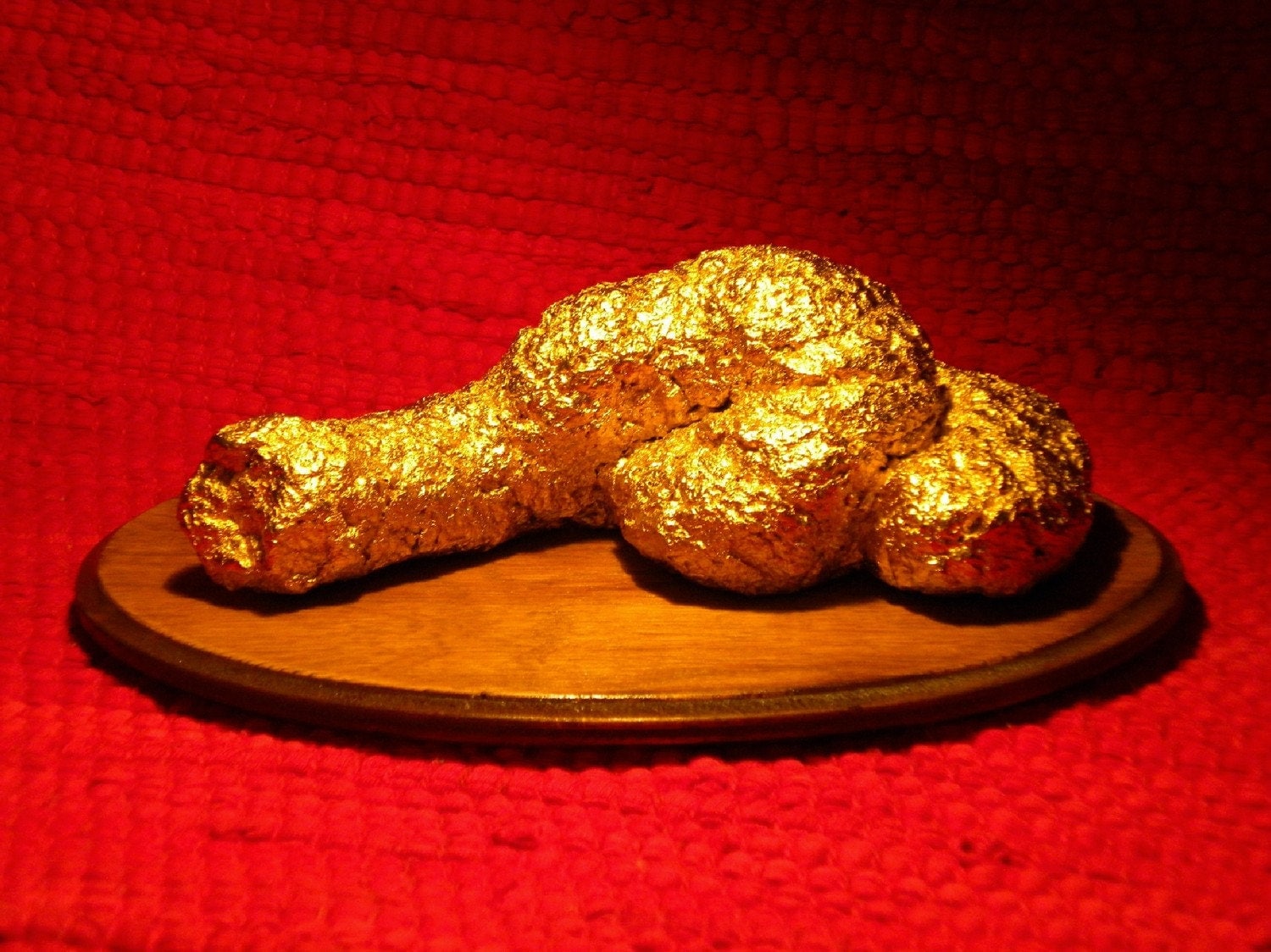
The Devil's Dung
– a peculiar gold nugget shaped exactly like a piece of human faeces that sits in a sealed jar of water and gives off a continual stream of bubbles. A gas valve is fitted into the lid and a servant opens this once a month in a spot on the edge of Lambeth Marsh as the gas has an unbelievably noxious stench. The water will also be observed to glow a faint blue in darkness, and adding a drop of holy water will result in a red bloody stain which disperses over the space of several minutes. Mr Tradescant has invited Mr Arthur Dee, son of the famous Dr John Dee, to experiment with the gas and he has found it toxic to plants, animals and spiders, but curiously not worms or cockroaches.

A still from Lair of the White Worm, dir. Ken Russell. Watch it!

A Scale from the Lambton Worm
– A large white translucent scale three inches across of the same general shape and conformation as a snake scale. Faint patterns may be discerned if it is held up to the light, perhaps words written in an unknown alphabet. Mr William Kember, a scholar, translated these words and though Tradescant doesn't have an exact transcript he was told that it is a poem of the most extreme lasciviousness and lewdness unsuitable for Christian ears.

From Image Arcade

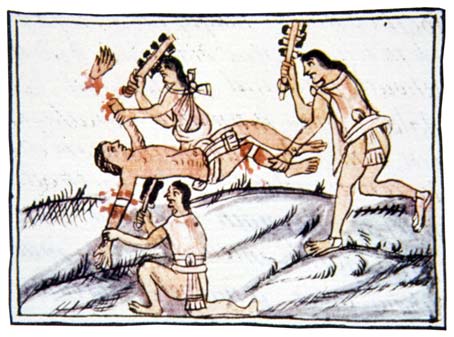
The Maquahuitl of Montezuma
– an example of the Aztecs' favourite wood and obsidian hand weapon, kept alongside a rather threadbare but still brightly coloured feather and bead cloak. The maquahuitl is missing a couple of obsidian blades, has Aztec glyphs running down the shaft on both sides and a fanged monkey skull threaded onto the thong on the human skin bound handle, plus dried lumps of bone, hair and tissue from the last person brained with the thing stuck between the extant blades on one side. A gloriously gruesome and exotic relic, even hardened mercenaries from the Wars of Religion in Europe quail a bit when they see it, and few dare wield it. Tradescant keep it in a specially made wooden case as it scares the willies out of his servants when they come down to the Ark to do the cleaning and his pet bulldog, Hector, is banned from the room as he always sits by the box howling piteously.

From www.ashmolean.org, can be seen in the Ashmolean Museum in Oxford


The Mantle of Powhatan – Powhatan was the father of Pocahontas, a Native American girl who created quite a stir when she visited London in 1616. Anyone familiar with the Tsenacommacah of Virginia will recognise it as a ceremonial wall hanging, not a mantle or cloak, and has a simple design of a human figure flanked by two deer against a pattern of circles, all made by sewing shells to a piece of deer hide. Tredescant acquired it in Virginia, he says he bought it from Opechanacough, Powhatan's successor as paramount chief of Tsenacommacah, but those who know of him might realise this is unlikely as he hates the English with a passion and was responsible for the massacre of 1622 when a third of the colonists in Virginia were killed in a surprise attack in the James River valley. Tradescant also has a bottle of poisoned whiskey from the batch Dr John Potts used to kill 200 Tsenacommacah at a 'peace feast' in Jamestown in 1625.

Sunday, 22 February 2015

Lore Garbage

Kiel Chenier has suggested over on G+ that for DM appreciation month (never knew there was one until now) DMs should waffle self-indulgently about useless things about their own game world. I need very little encouragement to waffle, so here are ten bits of trivia about the fantasy English Civil War:

1. As far as practitioners are concerned there are two sorts of magic; witchcraft as practised by uneducated peasants and sorcery, practised by educated gentlemen. In truth it is all the same; the same effects are achieved by both in similar ways. The chief difference is in language. Witches say their spells in English, with maybe a bit of old Anglo-Saxon, Cornish or Welsh, Sorcerers tend towards educated tongues like Latin, Greek, Hebrew and Arabic or even for followers of Dr Dee, Enochian, the language of the Angels. Though even that distinction is breaking down as since the Reformation more and more Sorcerers are finding that spells in vernacular languages work well enough.

2. If you are a magician researching spells you need a library, and many religious works are as good a source of magical knowledge as any. No magician in England is without a Bible (though the Old Testament is worth a mere 50sp for research purposes and the New Testament another 25sp) and the Talmud and Koran weigh in at 50sp each. Giordano Bruno got himself burned at the stake for openly saying that the Bible is a manual of magic, and if someone can divine all its secrets they will be a master of such. More abstruse religious works such as the Liber Divinorum Operum by Hildegard of Bingen or the Mirror of Simple Souls by Margaret Porete are worth a lot more as research material, but possession of such night be considered heresy by  various churches.

3. Clerics can research spells as well, and they can often do so by reading the same kinds of books as magicians. The Bible and religious works are worth a lot more to them, but works by religiously minded sorcerers like Pico della Mirandola are pretty good too. Again the spectre of Heresy rears its ugly head. An Anglican who openly quotes the Koran while giving blessings is looking for a painful defrocking.

4. The Ranter prophet Abiezer Coppe is only 23 in 1642 when the wars begin in England, not long out of Oxford University, but he is already making his mark with his impassioned preaching and advocacy of free love and anarchism. One of his key slanders against the Anglican Church is his insistence that various Bishops are up to their eyeballs in witchcraft.

5. Sightings of mythical beasts have always been common in rural England due to a combination of excessively cheap ale and benighted ignorance. Now learned men are taking an interest in such matters, and there is a definite feeling that something awful is happening to the fabric of mundane reality. The Reverend Dr Samuel Fell, former chaplain to King James and supporter of King Charles, is interested in any such outbreaks and is rumoured to be sending exorcist spies to investigate them. He blames the Puritans for questioning the doctrines of the Anglican Church, but was himself a Calvinist in his youth.


6. Prince Rupert's dog, Boye, is a hunting poodle of a rare breed and is reputed to have magical powers, including leaping up and snatching musket balls aimed at his master out of the air. The Ottoman Caliph, Murad IV, wants one just like him and if you can dognap Boye for him he might award you some of his fabulous wealth.

7. Mother Shipton's prophecies are all the rage since they were published in 1641, and many a wacko theory of impending doom has been hatched on the basis of reading portentious poems such as: When pictures seem alive with movements free, When boats like fishes swim beneath the sea. When men like birds shall scour the sky. Then half the world, deep drenched in blood shall die. Watch out for the Hag's Head moths that have Mother Shipton's profile marked on each wing.

8. The Royal Navy is now Parliament's Navy, the whole lot mutinied and are having a whale of a time drinking themselves stupid in every port town in England. Trouble is that the Barbary Corsairs never went away - sure there were treaties to stop their razzias and slave raids but don't forget Jan Janszoon, the Dutch Muslim renegade, once took over the Isle of Lundy in the Bristol Channel and used it as a slave market for five years from 1627. They had better sober up and get back out on patrol...

9. Bermuda is run by the Somer's Isle Company, a collection of nobles who support the King. The Parliamentarian population of Bermuda may yet rebel; the North American tribesmen sent to Bermuda as slaves after the Pequot War in Massachusetts may still have some fight in them, if they can be induced to fight. Others have left with the Eleutheran Adventurers to establish a religiously free (ie Puritan) colony in the Bahamas, though the last expedition sent that way was lost...

10. Men can turn into wolves. It is a well attested phenomenon that during the German wars men who had seen too much of the blood and terror of those interminable campaigns, still raging on, have become conscienceless beasts and eat human flesh. And it wasn't just foreigners who were so weak, oh no, English and Irish mercenaries were known to partake of the anthrophagous feasts as well, and many such men have returned to England to fight for and against the King. It will be a savage war...


Sunday, 15 February 2015

Scarabomancy


Ohe! 

Let it be known among the wise that the ancient and most perfect art of Scarabomancy has been rediscovered and that lectures in such will commence in Tumissa on 12 Fesru, at the gong of Awakening in Azure at the Temple of Ksarul .

Herein I shall outline for the curious what this art entails, for in this decadent age few, even among the wisest of the wise the adherents of the Doomed Prince, have even heard of this most marvellous method of divination and interpretation of the knots of Skeins of Destiny.

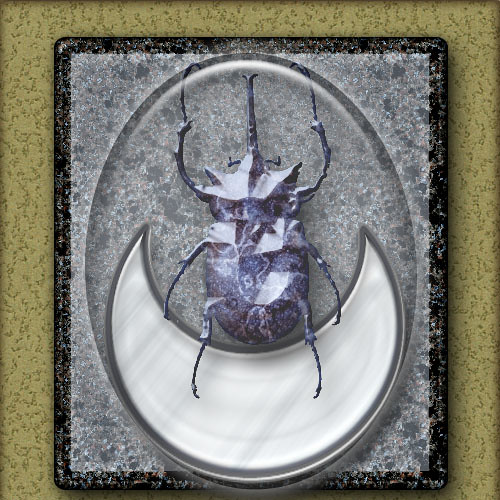
First you need a scarab beetle, obviously. This attractive little beetle is most sacred to Ksarul, master of the most mighty beetles that roll the planets and moons through the sky, and himself manifest in the great fireproof beast that moves the sun itself. Each scarab is, in a minute and most infinitesimal way, an aspect of Ksarul himself and thus can impart wisdom from beyond this most prosaic of planes.

Second you will need chalk and a bit of flat floor, and on it you shall inscribe the Ten-Fold Circle of Fate and the Fifty-Five glyphs of the Tongue of the Scarab (copies available from myself after the lecture, price 50 kaitars and worth every qirgal). The very best method is to permanently incise the Circle on the floor of a dedicated Shrine of the Scarab, but as the Provost of the Fabric of the Sacred Space has no spare rooms at the moment, I will instruct students in the use of Mriddu’s chalk.

Thirdly, you will need pen, ink and paper, and fourthly, the most important ingredient, dung. Most dung will do, chlen is ideal, but hma and hmelu do just as well. Do not be tempted to use human dung! It is easily available (all too easily given the woeful culinary standards of the Tumissan temple refectory) but the stench is awful, the consistency poor and it will make your scarab ill, if he can be persuaded to approach the stuff at all.

The procedure is as follows:

Ask the questioner (or yourself (but not out loud or people will think you mad (which I am not))), to state their request of the Mightiest and Wisest of Gods in no more than thirteen words and two symbols of punctuation. Write this question, in any language, scarab beetles are perfectly multilingual like their master, on a piece of paper two choptse wide by one hoi long and roll it into as tight a cylinder as you can.

Take a lump of dung, ten mlo will do nicely, but a weak or small beetle might only be able to cope with seven or eight, and roll it into a ball. Insert the question into the ball of dung and place it on the Glyph of Questioning in the very centre of the circle.

Take a Darsha leaf, and roll it round a mlo of Aira grass, a mlo of Chumaz, three mlo of Hnequ weed and a pinch (and believe me, only a pinch) of dried Urugal root. Set fire to the roll of herbs and inhale the smoke in Loruni fashion. When the room has stopped spinning, get your scarab and blow upon it the smoke. When the scarab has stopped waving its legs in the air and coughing place it on the circle at the Glyph of Wisdom (that’s the big square one).

Observe closely the path it takes to the question using the left eye, and then observe closely the path by which it rolls the ball of dung out of the circle using the right eye. Do not use both eyes at once! If this process takes more than two kiren you have probably used too much Aira grass. If you lose consciousness before the end of the process I suggest you use fresher Chumaz, and if you find yourself distracted by the green translucent Vringalu singing Pijenan drinking songs you have used too much Urugal root and should seek professional demonological help immediately.

By analysing the path of the sacred scarab it is possible, with practice, to determine with amazing accuracy the course of the questioners skein of destiny with respect to his question. So if you are asked ‘Ohe, shall I wed the handsome mat weaver or the ugly slave merchant?’ and the scarab crosses the Glyph of the Impaled Ahoggya, the Glyph of the Left-Centre Eye of the Zrne and then abandons its ball of dung on the Glyph of the Missing Finger and bites the questioner, the answer is of course neither you silly person, you are going on a long sea voyage in the course of which you will inevitably drown.

The many relations of Glyphs to knots of fate are detailed in the scroll ‘Key to the Skein of the Scarab, or Silly Answers to Stupid Questions’ by the mighty seer Arkha’anu the five-legged, who himself was a scarab, so he should know. Copies of this are being produced in the scriptorium of the Plume of White clan for those students willing to take ship on this barge of most excellent wisdom to its ultimate destination, the Sea of Fate itself.

Oh, yes, the last stage of the process is wash your hands.

Rusala Yi’isia hiNashomai, Friend of the Scarab, Twitcher of the Refulgent Blue Curtain and Kusijaktodali of the Temple of Azure Ambivalence, Teacher of Scarabomancy

All hail Ksarul!

Saturday, 14 February 2015

Yan, Tan, Tethera, Methera


I am currently re-reading a book I last read when I was maybe eight or nine, the Cuckoo Tree by Joan Aiken. It is set in an alternate 18th or 19th Century (it isn't clear which) and among the fine collection of grotesques and rascals decorating it's pages are a gang of Smugglers called the Wineberry Men. Aiken did her research well, smuggling was a big deal in England's past, and my own reading has shown that it is entirely plausible to suggest that the early 17th Century could have been it's origin as a big business.

Tonnage and Poundage

It was all about the money. It had been traditional for centuries for Parliament to vote newly crowned kings of England the right to levy 'Tonnage and Poundage', customs duties on goods entering and leaving English ports. King James I had however abused the system. He upped the rates, levied extra surcharges and put the whole operation under the control of customs farmers. These were consortia of rich merchants and aristocrats who paid the king a fixed annual rent for the right to take duties at ports; they of course hoped to make a profit, and brought a keenness and rigour to the task that the easygoing Royal officers had always lacked. However this early attempt to privatise public services went about as well in the 17th century as similar efforts have in recent decades; the system was full of corruption and the new farmers were accused of all sorts of abuses, but the king got a regular income and he had saved himself and him ministers a dreary administrative burden so he was happy.

When his son Charles came to the throne Parliament refused to vote him Tonnage and Poundage until the abuses had been stopped. He carried on levying the duty anyway through the farming companies his father had used. Parliament declared the imposts illegal and in not so many words implied the king was a thief, one of the reasons Charles refused to call a Parliament for over a decade, until his disastrous handling of the Bishop's War in Scotland forced him to.

The Owlers

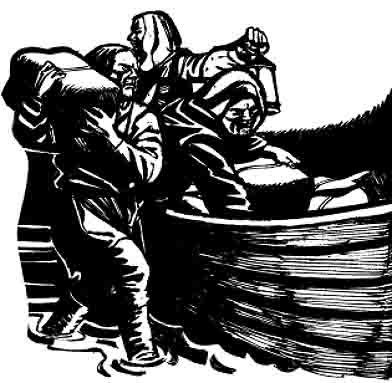
The chief item being smuggled was wool. There had been efforts throughout the later middle ages and Tudor period to transplant Flemish weavers to England, but most English wool was still going to the continent to be made up into cloth and wool duties made up most of the customs income. The Owlers were smuggling gangs who spirited the stuff away in the middle of the night, and hundreds of armed men were engaged in the trade to fight off the privatised excise agents.

Woolpacks

Packing wool for export involves compressing the rather low density fleeces into compact packs by sticking it in a wooden form with a square jute bag inside, stamping it down and sewing it shut. The packs are about two foot by tow foot by three and are damned heavy – an oversized item in the LotFP rules – and these are bound up by rope into gigantic packs weighing twenty-six stones. The importance of the wool trade to the economy is symbolised by the Lord Chancellor sitting on a woolpack in Parliament.

They are also ideal for smuggling. Once the pack is sewn shut no one is keen to cut it open as it will be the devils job to get it all back in, and all kinds of stuff can be hidden in the padded depths of a woolpack. In the early seventeenth century sugar and tobacco were starting to be brought into England from her newly founded colonies in the Americas and Caribbean. There had always been a good trade in imported wine, especially fortified wine like port and brandy – tonnage was in fact 'tunnage', a levy charged per tun (barrel) of wine.

Counting Sheep

Back when the Anglo Saxons invaded the British Isles everyone spoke Celtic. Over most of Britain the Celtic language died out and there are remarkably few Celtic loan words in modern English, but somehow it hung on in counting systems for sheep. There are many local variants of this counting system and a gang of smugglers called the Riggwelters (the local dialect for sheep on its back that can't get itself upright due to a heavy fleece) in Lincolnshire use the words as code names. From one to ten the numbers are; Yan, Tan, Tethera, Methera, Pimp, Sethera, Hethera, Hovera, Covera, Dik.

Any, all or none of the following reprobates may be members of the gang;


  • The Vicar of Holbeach St Marks, the Reverend Dr William Toad. Toad is a local man, son of the previous smuggler 'king' who made enough money to send his son to Cambridge to study Divinity. William's position in the Church of England used to put him above all suspicion, but the local Puritans have no respect and openly accuse him of all sorts of crimes in the street, some of which are actually true. He's dying to have a couple entombed alive in woolpacks and dumped in the salt marshes in the local version of the mafia concrete boots, but prudence has so far stayed his hand; but with a war on all kinds of vengeance may be possible.
  • Lucy Hay, Countess of Carlisle. A society beauty and cousin of the Parliamentarian general the Earl of Essex, Lucy's husband is one of the chief investors in the Yarmouth Customs Farm. Lucy goes through his papers tipping off her smuggler cohorts as to their operations. She got into the trade in her youth; her father is the Earl of Northumberland, who made deals with his local Owlers to get the wool from his estates to market without paying the King his cut. Lucy has gone the whole hog and become an Owler herself.
  • Lionel Pepys, Norwich gadabout. Lionel learned witchcraft in his youth from his grandmother, being particularly adept at spells of charm and illusion. He lives a fine life among the provincial gentry and aspires to be published poet, while at the same time ordering his rival Owlers kneecapped with blunderbusses and gifting them mutton pies laced with scrapie infected sheep brain.
  • Toby 'the Frog' Letchworth, customs clerk. Officially a customs officer, he went over to the Owlers long ago, and cheerfully abuses his position as Land-Waiter at Yarmouth to intercept goods being brought in by rival smugglers from abroad and appropriate them for himself. He usually haunts the 'Happy Flounder' alehouse in Yarmouth, an obese oaf with a broad grin who holds court in a backroom with his bewarted cronies. Actually immensely strong and can fold a silver sixpence in two round a whispered curse with his fingers, and have it planted on a man he wants harmed by a nimble fingered potboy.
  • Diligence 'Ma' Lubbage, confectioner. Ma smuggles Caribbean sugar and spices from the far east and even chocolate, though the early 17th century version is more closely related to the bitter drink of the Aztecs than the modern sweet. Has an African slave working at her shop in Norwich who helps her cast spells and adds various dubious herbs to her sugar loaves to make them addictive and much in demand. Half hearted knife fights between podgy addicts have broken out in alleyways over her 'sweets'.
  • Harry Dangerman, 'I am not the Sethera, I am a free man!'. Harry claims he is forced into being a smuggler by witchcraft but he may have just partken in too much of the potent hashish and opium he picks up from Levantine company traders in Amsterdam. Says he is haunted by the ghosts of dead rivals who follow him around with their mouths stuffed with wool and that he was once ambushed by a demon shaped like a great white bladder filled with air when he tried to quit the business.
  • Piet Vanderboer, sea captain. Known as 'Vanderbastard' by his crew, Piet is a Calvinist who dresses in bible black and a fierce disciplinarian who will keel haul a man for picking his nose on deck. His rather unique theological view is that all tithes and taxes are inspired by Satan to prevent God-fearing merchants like himself making a living, and that the guilds of sailors and tradesmen who try and set wages and trade practices are devil worshippers. The Hidden Hand of God works his miracles of prosperity through markets, and his blessing is reflected in the gift of wealth to the Godly. More conventional types wonder if he has mistaken Mammon for Jesus, but he always has a suitable Bible quote to justify his many acts of fraud, piracy and murder.
  • Lillian 'Poxy Lil' Lasalle, gun runner. Lillian was a much in demand prostitute until smallpox ruined her looks. She learned to hate the gentry and their wicked ways while she was on the game and is now an ardent Parliamentarian who brings in firearms from the continent to supply the various pockets of resisters in Royalist dominated areas like the South West and Ireland. She has contacts in the perfume trade in France and can source poisoned Eau de Cologne.
  • Gerard 'the Giblet' Smethwick, butcher and poulterer. Runs his contraband overland on the backs of pigs with the aid of his swineherds and he and his confederates retail their smuggled goods in their butcher shops, just ask for the 'special meat'. Sometimes you will get just that, special pork-tasting pies with a good thick crust and plenty of pig-trotter jelly and maybe the odd toenail.
  • Michael Maunder, publican. Runs the 'Fighting Cock' alehouse known for its cheap beer and lively cockfighting scene. Will dope his own birds on 'Colombian snuff' and watch them rip the shreds out of his rivals and then offer the losers the chance to work off their gambling debts by carrying a woolpack for him. Woebetide someone who dies not play their part, Michael is a witch with a talent for spells of seeking and finding, and marks all his packs with rune carved magic bones for easy recovery.