Tuesday, 20 October 2015

The Moon Lens

The Moon Lens is a discus shaped object twelve inches in diameter and a kilogram in weight. It is mainly made of a porous and crumbly grey rock, pitted in places and scorched black and melted in others with radial striations carved on one side. It has a copper coloured metal band round the circumference with engraved symbols. In the centre of the disc is a cylinder of quartz about an inch wide running through it, though its internal fractures and some cloudy patches make it impossible to see all the way through clearly. It can be thrown, but it is unwieldy and hard to aim.


The writing is in the Cretan Linear A alphabet and encodes four magic words which can be used by the last person to hold the object. There are a few other symbols, some obvious depictions of stars and of phases of the moon, other more obscure.

'Urnentu' makes the object temporarily weigh just a few milligrams. It can be thrown a quite ridiculous distance while in this state. A man with 18 strength and good discus technique could throw it into a low orbit.

'Gertu' will return the object's weight and bring it back from orbit to the user. It will scream down from the sky as a meteorite would and will thump into the ground with considerable force. It will be incredibly hot from re-entry and will take a good four hours to cool. It will hit somewhere within sixty feet of the user and if it hits a structure in that area the structure will suffer severe damage. If it falls into water it will sink in a gout of steam and will need recovery from the bottom. It was not designed to float and there is a 50% chance that the thing will crack from its too sudden cooling and become useless if it hist cold water. The Moon Lens will not return if it is on the ground, the word will merely make it heavy once again.

'Irki' will cause a light to shine from within the quartz, focussed in a narrow cone that is maybe an centimetre wide at a distance of ten feet. It is barely detectable at twenty feet as it is not very bright.

'Bidtuko' will make anything fully enclosed by the cone of light on the striated side teleport to any surface touched by the cone of light on the other, plain side, moving instantaneously. You have to be two hundred miles away to have a cone wide enough for a human to be so transported, and the effect works in straight lines only – the curvature of the earth is not taken into account by the device, so it has to be well above the horizon on the peak of a very tall mountain and will shoot the user somewhere into the depths of space. Transport is one way unless the user find some cunning way to turn the disc over while it is hundreds of miles away in the depths of space.

Using Comprehend Languages on these words will tell you their meanings – Furthest, Closest, Open and Travel – but not how to pronounce them and thus activate the magic. That will take the recovery of some Cretan inscriptions in both Linear A and B and a ferocious amount of linguistic knowledge to work out the sound values of each letter; the logograms between these magic words will remain undecipherable by any means. The language may be recognised as a remote ancestor of Basque.

The lens was made by an ancient civilisation who had somehow fallen out with the Selenites and wanted to invade the moon. With knowledge of Newton's Principia and Opticks (the Method of Fluxions wouldn't hurt either) and a really big and a well engineered catapult capable of shooting the thing into a precise orbit with the striated side facing Earth, it should be possible to calculate when the light beams are facing from Earth to Moon, how large they are and where they fall and with a word transport a body of men from Earth to Moon – where they will probably promptly suffocate from lack of air as the original invaders did back in 2000BCE. 

Newton and other natural philosophers will have the necessary maths worked out by the 1710's, though an army of 'calculators' will be needed to work all the arithmetic out by hand, sufficient engineering precision will be achieved by 1730 when accurate sextants become available, though lack of knowledge of the speed of light and of special relativity will make planning any transfer further than the Moon a very dicey proposition until the 1930s.

Mucking around with it as it flies around in low Earth orbit, the best most adventuring parties are going to manage, will randomly shoot objects and people from Earth into space and from space back to random locations on Earth as the magic words are abused. Until they get a handle of what is going on there will be a spate of disappearances they may only hear about by rumour or news pamphlet, and if the disc is flying upside down all kinds of random interstellar crap might end up back on Earth, from deposits of moondust, toxic interstellar gas clouds (by far the most likely option) or wisps of the atmosphere of Jupiter, rains of fire as bits of a stellar corona turn up at ground level, and if the PCs are very unlucky and their GM is very evil, the sudden irruption of an asteroid or misplaced aliens from a planet far, far away.


In addition the Selenites aren't stupid. They remember well when the ancient Atlanteans tried to invade and (after laughing until their spiracles hurt) regularly check with their surface observatories for the tell tale flashes of magical light from below even after all these millennia. Their troglodyte civilisation is not what it was, but is still capable of launching a spaceship to go investigate what those idiots from Earth are up to now.

Saturday, 17 October 2015

101 Uses of a Hanged Man


The gibbet was a metal cage in which dead criminals were displayed pour encourager les autres. They were pretty popular in England in the 16th and 17th century and were still used as late as 1832. The usual procedure was to hang the criminal first and then put the corpse in the pretty closely fitting cage, but on occasion people were gibbeted alive and just left to hang and die of thirst and starvation.

This practise is a boon to sorcerers and witches; there a lot of useful magic in a hanged man.


Magic Item Lore in 17th Century England

There are no end of sources for recipes for magical potions and charms from old Greek and sources like Pythagoras, Empedocles and Apollonius of Tyana, recycled by way of medieval and modern writers and through word of mouth among the witches. The trouble is no two sources agree on all the details involved in their manufacture.

For any given item there are 2-12 key phases of creation; more for more potent items, fewer for the less potent. The GM should determine the true method for each phase; prepare at least two options and roll d10 On a 1-3 the first option is correct, on 5-6 the second option is and on a 7-10 the step is in fact of no importance and reduce the potency of the final magic item by -1/# of steps; a magic item that has no risk or difficulty in its creation has no power to affect reality. Thus a mandrake root has six steps to create; each step that turns out to be bogus reduces final potency by 1/6. Always round down at the end of the process.

For each step invent a bad result for getting the stage wrong. This may be anything from a loss of potency in the final item through to risk of death or localised or even global natural disaster.

Now roll for the magic user researching the issue; for each 4d6 days working on the matter at 20sp a day in experiments, bribing demented witches with parsnip wine, cutting pages from library books with a razor blade, pulling scrabble letters out of a peasant's hat etc. the GM should secretly roll 1d10 for ONE of the steps in the process adding the PCs Wis bonus;

4 or under – They have a definite answer! (And it is wrong!);

5 They have both answers and cannot make up their minds which is right, they will have to guess

6 They are sure the step is irrelevant, or at least no one has mentioned it being important in their research

7+ They definitely know the right answer!

The PC will not know how many steps will need to be worked on, at least not at first. After the first period of research tell them a variable number of steps equal to (the true number -1d6) to (the true number +1d6), after the second +/-1d5 etc.


Part 1: The Mandrake

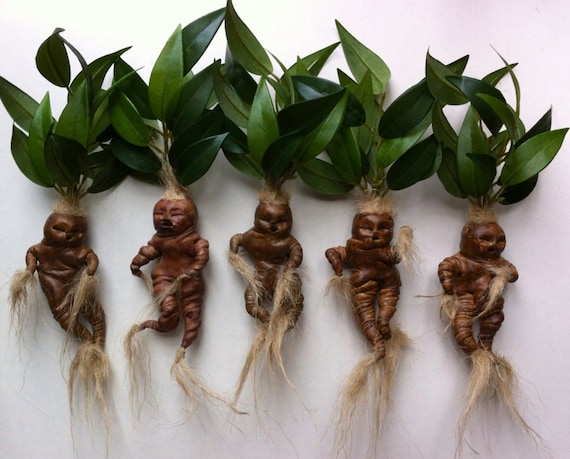
You can buy these on Etsy.


When a man is hung as his neck snaps all kinds of autonomic nervous responses are triggered, including ejaculation. On the spot where the semen hits the ground a mandrake root will grow, taking 1d20+1 days to reach maturity.

Digging up a mandrake is no easy task and no two sources agree precisely what the proper procedure is and some modern herbalists say that digging up a mandrake is no more hazardous than pulling up a parsnip.

Step 1

A. To ensure your Mandrake is ready look for green leaves and a round bud on a stalk like a thistle; OR

B. Listen carefully at the ground at sunset to hear the mandrake say it's prayers to the Devil. 

If you get it wrong the potency of the mandrake is reduced by 1/6

Step 2

A. You must start at sunset OR

B. you must start at midnight.

If he gets it wrong the digger must save vs magic or any following saves and other rolls made during the rest of the procedure will be at -2, any devils summoned will have +1d8 HP and and extra +1 Cbt bonus, potency of the mandrake will be reduced by 1/6.

Step 3

A. You must work slowly, not finishing the unearthing until sunrise; OR

B. You must work quickly to avoid notice by the devils below, unearthing the thing in five minutes or less.

Getting this wrong will result in an attack by a minor earth demon, a giant worm with a grinning face and covered in sticky mucus (AC 8, HP 4d8, Cbt +4, Damage 1d3 constriction plus wrestling; Str bonus for wrestling +1d3). These creatures will do an automatic 1d3 per round constriction unless defeated in wrestling, and if they beat their target they will drag it 1d3 feet into the ground. Six feet under and you begin to suffocate. Have one devil per four levels of PCs involved. And the final potency of the mandrake will be reduced by 1/6.

Step 4

A. You must either scratch three circles around the mandrake with a double edged sword that has never drawn blood; OR

B. You must sprinkle the ground with the urine of a nun.

Get this wrong and you will be attacked by devils as at stage 4 above, and the potency of the mandrake will be reduced by 1/6. 


Step 5


A. The root will emit an ear splitting scream when pulled up which will kill all who hear it. This may be avoided by plugging one's ears with wax; OR

B. One must tie the root to a dog's tail and run away tossing a piece of meat behind you to make the dog leap and pull the root free – you will hopefully be out of earshot but the dog will die.

Hearing the scream requires a save vs Paralyze. All hearers will be deafened for 1d3 hours and any local residents or watchmen will be alerted whether they save or not.

Amount save failed by:

1 Deafness for 1d6 days

2 As above plus permanent tinnitus; -2 to any listen rolls, partially deaf.

3 Permanent deafness.

4 Scream reverberates in the skull, lose d3 Int and d3 Wis

5 Eardrums burst, 2d4 damage, reverberation as above, permanent deafness.

6 Eardrums burst and lose consciousness for 1d3 hours, plus reverberation and deafness.

7 Stroke plus all of above effects. Lose d6 Dex and save vs death again or lose another d6 Int and d6 Wis.

8+ Death.

If this step is not deemed important the Mandrake will be utterly silent as it is unearthed and will have its potency reduced by 2/6.


Step 6


The Devil is particularly keen on this root, he made it himself with a little bit of the clay left over from God's fashioning of Adam. Once you have unearthed it you must:

A. Pray to the Archangel Michael to protect you from the Devil's ire; OR

B: You must pray to the Devil himself for forgiveness.

If you get it wrong make a save vs Magic or the Devil curses you; you will acquire the mark of the devil somewhere upon your person, you will lose a level per year, lose 1 stat point at random a week to various chronic illnesses and have -2 on all saves. You will be unable to enter a church and if you try there will be a peal of thunder and the church tower will be struck by lightning. Animals will be scared of you, your horse will throw you, there shall be rains of blood and/or toads on your birthday, you will never win at cards or dice and your mother will forget you exist.

Praying to the Archangel Michael after the curse has been laid is possible; this is effectively a Remove Curse spell and will get you another save vs magic, but at -4 on the dice, and the Cleric casting the spell for you must save vs magic him/herself or be similarly cursed.

It may be possible to get a suitably corrupt priest or daring magician to summon the Devil so you can apologise and make a deal for the lifting of the curse.

Using Remove Curse will give another save, but at -4, and the cleric who cast it must save vs magic or come under the same curse as above.

Getting this last stage wrong will reduce the potency of the Mandrake to zero until the Archangel Michael gets the Devil off your back or you mollify the Devil with an apology or deal.

What does Mandrake actually do?


What doesn't it do! It's great stuff! It is used in love potions, flying potions, it can be used as a general good luck charm, it can ward off magic and evil spirits and even make you immune to weapons. Few witches and sorcerers will know all of the functions a mandrake can perform, but most will know at least one of them and can research the others as if they were a spell of the level noted below.

Roll 1d6 for the potency, add 1 per three magic-user levels, make any deductions as noted above.

A single mandrake may perform only one of the functions below at a time. Trying to get a Mandrake to change uses requires a save vs Magic by the owner, otherwise it dies.

Lucky Charm, Level 1

Gives 1d6 plus its potency in points to be used as the cleric Bless spell. These may be enhanced by regularly bathing it in milk or wine, feeding it black pudding, goose liver pate or possibly sweet biscuits (there's a bit of uncertainty about this) and dressing it in red silk or white satin. It may also prefer to be worn round the neck, or it may like to reside in a rosewood box at home. Getting this formula right will add it's potency worth of blessing points per month, with a 1 in 6 chance of the mandrake just getting fed up with you and stopping working or running away in the middle of the night. Do not overtax your mandrake; if it is ever reduced to zero points it's potency dies and it will never work again.


Warding off Evil Spirits and Magic, Level 2

Gives a bonus to all saves vs Spells and to other saves if the effect is being caused by an otherworldly or undead entity. The bonus is +1 for potency 1-3, +2 for 4-5 or +3 for 6 or above. Each failed save reduces the potency by 1, and when potency equals 1 the mandrake will run away unless kept prisoner in some way. This useage requires the mandrake to worn round the neck, and for small mustard seeds to be planted in cuts in its skin so that it grows a bushy green beard. An intelligent demon or undead entity may target it; it has an AC of 4 more than it's user and has 1 HP per level of potency, damage reducing it's effectiveness.


Love Potion, Level 1

Requires knowledge of Charm Person, and potion making expenses are reduced to 25sp a day. The love potions made from slices of mandrake are not in fact any better than ones made from other ingredients. One potion may be made per potency of the root, which has a disconcerting habit of screaming while the alchemist cuts or grates off the necessary quantity.


Flying Ointment, Level 3

Requires knowledge of the spell Fly and reduces the cost of making such potions to 10sp a day, an absolute bargain. One fly ointment can be made per root and it will last 1 turn per potency of the root +/- 1d3 turns, a minimum of 1 turn. The user will not know the duration beforehand and can be surprised when it suddenly fizzles out. The greasy ointment is applied to rectal or vaginal mucosa, traditionally with a broom-handle. Taking it orally will result in a save vs Poison at +4, with a fail leading to death, and a success to 1d6 hours tripping your nuts off thinking you are flying.


An Interesting Smoke, level 1

http://theblackapple.typepad.com/inside_a_black_apple/2010/06/


Drying the root and grinding it into powder, a piteous process involving much wailing from the expiring mandrake, and then mixing it with tobacco will result in interesting visions as the users spirit leaves his body and wanders the real or numinous worlds. The dosage has to be just right though – too little and all the user gets is nauseous, too much and the heart rate soars and he suffers a heart attack or stroke. Save vs poison at +2 plus the Int bonus of the druggist who prepared the mix three times. 

One fail results in nasuea and 6+3d6 hours illness, two fails result in brain damage with the loss of 1d6 Int and 1d6 Dex, three fails in heart attack and death. If the person has used Mandrake in this way before they get +2 to the save as they build up a tolerance. One dose may be prepared per potency of the Mandrake, and will last 1d6 hours of useful visions and 2d6 further hours of stoned lassitude.

In any case roll 1d20 on this table and add 1 per previous trip:

1 Soul wanders round the room, cannot stray more than 10' from body

2 Soul can travel 20' and can float upwards and go through walls

3 Soul can wander half a mile or so and can see into tiny areas like other people's pockets, can read things on the pages of closed books etc.

4 Soul wanders and is sucked in by a passing dog, rat or other animal. User spend next few hours living the life of a dog/rat etc and may be confused if they are a man who dreams he is a dog, or a dog dreaming he is a man and absent mindedly piss up a wall in public or chase a cat while thinking about it.

5 Soul inhabits a random inanimate object. Usually very, very boring.

6 Soul inhabits another random human being. No access to their secret thoughts but can follow their stream of consciousness and see through their eyes. Save vs Poison if you actually see them later or pass out with fright. If they are a magic user they will be aware of being spied on in this way.

7 Random human being who is ware of the presence of the users soul. Will accuse them of witchcraft if met later or if known to them.

8 Inhabits a random animal but has conscious control over that animal. If the animal dies, so does he.

9 Random inanimate object, but has four dimensional vision of that object from its first creation to its ultimate destruction.

10 Visions of peculiar intensity, witness an event from the past that has left a presence in the now. May be utterly inexplicable and uninterpretable. Gain 1d100XP or lose 1d100XP.

11 Roll again, but also meet another wandering soul, possibly from another time, another dimension or from outer space. No meaningful communication, but a lingering sense of paranoia. THE OWLS ARE NOT WHAT THEY SEEM.

12 Spirit wanders up to 10 miles, but can gain control of wandering and can consciously occupy another being if they fail a save vs magic, though not control them.

13 Inhabit a person's dreams and communicate with them through a dream. Will accuse you of witchcraft when they awake.

14 Spirit really wanders. Travels into Solar System, sees planets, asteroids, meets consciousnesses thereon though memories are vague. Inhabitants of Moon very hostile, save vs Magic or be captured by them and forced to fight peculiar disembodied battle with disembodied spirit-robot psi-cyborgs to escape.

15 Spirit wanders among the abstract forces of the universe in a state of synaesthesia, tasting gravity, hearing photons flit by and watching the enigmatic pneuma of Ain Soth Aur drift through the veils of Daath and trickle down through the higher Sephiroth to drip from Yesod into the porous back of their own skull which is of course Malkuth. +2d100XP if a magic user, -4d100XP if a cleric, utterly bamboozled if a fighter or specialist. Refuse to touch the bloody stuff again unless save vs Magic.

16 Accidentally attract the attention of a demon. Roll on the LotFP Summon tables for a being of your level +1d6-1d6 in HD, arrives at your physical location in reality, will eat you.

17 Attract attention of an otherworldy being who will try and occupy your body and do weird things while inhabiting it while your soul drifts about watching helplessly from nearby.

18 You wake up on Tekumel inhabiting the body of someone who has just had a terrible trip at a Dlamelish Temple orgy. Just what was that dull, cold and rainy plane you were hallucinating again? England? Boring!

19 You don't want to go back. Re-roll for nature of experience, but stay comatose for days, when you awake you lose 1d3 CON permanently and must save vs Magic or get the urge to do it all again, losing 1 WIS per day you are prevented from doing so unless somehow cured of the addiction.

20+ May choose to have a hallucination one has had before, or roll for a new one.


Immunity to Weapons, Level 5

The Mandrake root is dressed in clothes as close to the users as possible, fragments of his fingernails, hair and blood are put into a small cut in its side and it is kept in a rosewood box and fed on the blood of your enemies.

While you have the mandrake it has 1d6+1HP per point of potency. Any damage taken is taken off the mandrake, wherever it may be, and will not affect the user until all these HP are gone. The mandrake can be healed with all the usual cure spells, or fed blood of defeated enemies to heal 1d6HP, but will not heal naturally. If it is reduced to zero HP it is dead.
The mandrake can be removed from its box and attacked and any damage done to it is taken off the owner first. Don't lose it.

Buying Mandrake Root

You can get mandrake 'under the counter' at most country fairs at prices ranging from a shilling up to ten pounds. Of course 99.9% of these roots are funny shaped parsnips and turnips that some con man has carved a face into and dressed up, or possibly given a mustard seed beard or hair. But the vendors can be a useful source of genuine mandrake root lore.

Psst... Wanna score?


Wednesday, 7 October 2015

Verum Jesuitarum Libellus


As every good Puritan in 17th Century England knows the Society of Jesus, the shock troops of the Counter-Reformation, dabble freely and extensively in foul and perverse sorcery.

Sometime in the 1570's a booklet entitled 'Verum Jesuitarum Libellus' – the True Petition of the Jesuits - began to circulate among Rosicrucians. It allegedly dated from 1508 and was verified as genuine magic by the great Heinrich Cornelius Agrippa himself.

This little pamphlet is much sought after by Protestant propagandists looking for solid proof the Jesuits are devil-mongers, and by magicians hoping that these rosary-swinging self-mortifying militant wierdos really have unearthed some earth shattering spells.

Notwithstanding the obvious fakery of the Libellus (the Jesuits weren't even founded until 1534, long after the alleged publication date and barely overlapping the last few months of Agrippa's life), it does have something magical about it, as any Magic User worthy of the name and literate in Latin will find out. And, oddly enough, Clerics can make use of it's contents too...

For a look at the original text, see link below:


Reading it


Anyone literate in Latin can read the Libellus and anyone can carry out the rituals described therein. This will usually do nothing, but 1 in 10 copies will be sufficiently imbued with other-worldly energies to act as a scroll with 1d6 uses, randomly distributed among the spells below. Once used the text remains and it can still be transcribed or used as the basis for spell research, though all further attempts to use the ritual 'out of the book' will fail.

A Magic User will need to use Read Magic to see the underlying spell through the Latin verbiage, but if they do they will cast the spell automatically; if they don't do this they will have to roll a d20, add Intelligence bonus and level and get 10+; Clerics need to roll a d20, adding their level and their Wisdom bonus and getting 10+; Fighters and Specialists roll d20 adding Intelligence, Wisdom, Charisma and Dex bonuses and scoring 20+. Any roll of 1 or below has resulted in an appropriate mishap, as determined by the GM.

Clerics can use the text to research the spells within, costing a mere 20sp per day. Magic Users need only to transcribe the spells as from a scroll to a spellbook.


The Spells


1. The Seven Conjurations

Magic User Level 3; Cleric Level 3
Duration: Instantaneous
Range 10'

These ritual invocations purport to put the caster in control of an evil spirit, embodied 'in a most beautiful, affable, and human form' and 'without causing any harm, without noise, lightning, or tempest, and without fear or trembling' and forcing it to retrieve millions of Spanish gold pieces.

The casting time is a day to prepare the appropriate symbols and documents and will require a bible, a cross, holy water and a blessed dagger that has never tasted blood.

The actual result is however very variable. Anyone thoughtless enough to cast it without using Protection from Evil first is liable to immediate attack from the Demon, and even then it will attack anyone nearby not so protected – best use the 5th level 10' radius version. Sanctuary spells don't hurt either.

The minimum HD of conjured Demon is 4, but for better results higher HD (up to twice the casters level) must be used. The Demon will always take a humanoid form, but will have 1d3 features from the Summon Appendages table and special powers as per the Summon table.

Domination rolls – 1d20 + Cha bonus + level + 1 for Protection from Evil +1 for Sanctuary for the caster then roll 1d20 +HD + number of powers for the demon. The caster can get +1d3 extra for casting it on one of the following Holy Days – Christmas, Easter, the Assumption of the BVM, the Feast of St Peter and St Paul, and All Saint's Day.


-5 or below You are screwed. The demon laughs at your piffling threats of damnation and tries to kill you, your friends, your dog, your horse and might just try and do for everyone in a three mile radius.

-4 to -1 The demon settles for killing anyone outside a Protection from Evil while laughing at the caster. Will teleport the caster closest blood relative or spouse to the spot and marmalise them in front of them. Will attack the caster if he attacks it.

0 to +3 Will demand one human sacrifice and won't do shit until he gets it. Will then act begrudgingly, retrieving 1d100 sp per HD it has, and it will be in the form of any spare gold and silver in the area not actually owned by anyone under a Protection from Evil, so expect a pile of loose change, jewellery, silver hairbrushes etc purloined from the nearest habitation. Caster loses 1 XP per sp of loot gained as it is spiritually 'dirty money'

+3 to +7 Will demand blood sacrifice. Lose 1 HP permanently to get the demon to act. It will bring 2d100 per HD worth of misc gold, silver and gems, purloined from local sources as before and with XP drain as before.

+7 to +11 May demand blood sacrifice (roll casters d20 + Cha bonus, get 10+ to dissuade it), but will return with 4d100 sp worth of loot per HD in the form of perfect fake gold coins of the usual local denomination and a save vs paralysis will halve the XP loss for getting it.

+12 or above The demon actually does it's job retrieving a million sp worth of loot. It will ask politely of the caster if they are sure a lesser sum wouldn't do, but if they insist they insist... The caster loses 1 million XP. If this reduces him to below zero (which it probably will) he collapses into a pile of bones, flesh, gore and gold coins to the value of 1sp per XP he had. His insubstantial spirit, now without material substance, will claw at the money as it fizzles away into the aether. If he has more than a million XP matters proceed as before, though he will have lost quite a few levels.


2. The Jesuit's Discharge

Magic User level 5, Cleric level 4
Duration: Instantaneous
Range: Sight

This spell enables a summoned demon that has got out of control to be dismissed. The caster rolls 1d20 and adds Cha bonus, level and Int or Wisdom bonus, the demon rolls 1d20 plus HD plus 1 per special ability. If the caster wins the demon departs. Sacrifices can help as per the Summon spell, +1 per 2HD, or 1HD if the victims are the same race as the caster. The spell description in the Libellus suggests use of a cross, but this isn't actually necessary. Will not work on any of the Abstract Demons.


3. The Conjuration of Usiel

Magic User level 1, Cleric level 1
Duration: 1d6 rounds per level of the caster
Range: Self

Usiel is the Strength of God, a 'fallen' angel who begat giants upon human women. Invoking him takes a round and temporarily replaces the caster with a self from an alternate universe who became a fighter. This fighter is of equal level to the caster with the same stats (re-roll HP and add Cbt bonus as appropriate, use appropriate saves) but adding 1d6 Str points and removing 1d6 Int. At the end of the spell the caster must save vs Paralysis (as his original class) at +4 or the transformation will be permanent. The new Fighter version of the character may recall an entire alternate history for himself and the world at large.


4. Cyprian's Citation of the Angels

This is no more than a version of Protection from Evil that can be used by a magic user. This spell has no reverse version though, and what qualifies as 'evil' can be a bit capricious. Plenty of 'demons' count as mere 'fallen angels' in the cosmic scheme of things it seems, and plenty of weird alien entities are not 'evil' as such, merely 'hungry', and there are 'angelic' beings who will turn you inside out for fun. Some philosophers suggest asking Koshchei the Deathless, he who created some things as they are, how it all works but few have managed to get such an interview and even fewer have survived it.


5. Cyprian's Conjuration

Magic User level 2, Cleric level 2
Duration: 1d6 rounds per level of caster
Range: 100'

This spell is a fancy version of Speak with Dead that specifically summons a spirit that has hidden a treasure. The spirit will moan pathetically about how boring it is being dead, how ungrateful it's children are, possibly mistake the caster for one of it's greedy offspring and berate him/her for calling it up just to scrounge money etc.

The person must be buried within 100 feet of the casting spot and will be of a level equal to the caster +1d4 -1d4. If the caster knows the name of a specific person he wishes to summon he can use it, but if the person is of higher level than he is the spirit gets a save vs Magic to refuse the summons.

The spirit will have 1d6 HP per level, whatever HP it had in life, AC 12 and will be insubstantial, taking no damage from physical weapons unless they are magical or have been blessed. They will have a Cbt bonus as they had in life, and hits will do 1d3 damage per level and drain 1d100 XP, both halved if a save vs Paralysis is made. If XP is reduced to 0 then the person drops dead of heart attack whatever HP they have left, and if somehow raised from the dead they will be zero-level and will need 1000Xp to be able to go up in levels again.

Spirits of Magic Users and Clerics will be able to to use magic as they could in life, and have a 50% chance per spell slot of having something memorised available.

The spirit will remain for 1d6 rounds per level of caster, but if it becomes angry it can stay for 1d6 rounds per own level.

Once 'slain' as a spirit this spell may not be used on a given individual again, you will have to find the bones and try a Speak with Dead. Spirits may retreat at any time and hide in their mortal remains. They can move through walls and other material objects at 120' a round and gravity has no effect on them. The only thing that can hold them in an 'inverted' version of Protection from Evil 10' radius, and they can escape that with a save vs Magic. Turn Undead will work on a spirit of the Dead, and they cannot walk into full daylight.

Once raised the spirit of the dead must be threatened or cajoled into revealing the location of its loot. Roll 1d20+Cha bonus+Int bonus plus level for the caster, and subtract (1d20 plus Cha bonus plus Wis bonus plus level) for the victim.


-8 or below Spirit of the dead hates you, will attack if equal of greater in level, will retreat if losing.

-3 to -7 Spirit of the dead is uncooperative, will just retreat back into the spirit world when able to. If summoned again take a further -2 from the reaction roll.

-2 to +2 Spirit of the Dead is unimpressed. Make a further argument as to why you should have their well hidden loot for a re roll. Fighting the spirit down to half HP or less is a good argument.

+3 to +7 Will state the nature OR the location of the loot. This may be followed up by the caster with a Locate Object spell, if within range of such.

+8 to +11 Will state location and nature of loot and maybe a hint or two as to how to look.

+12 or above Will actually warn of any traps, tricks or hazards involved in recovery of treasure.

The amount of loot available will vary considerably. In most cases there will be very little. People in Christian Europe are rarely buried with grave goods and most of their chattels are given to their heirs via wills. The Magic User may go through this rigmarole, fight a spirit of the dead, and then find that the 'treasure' is a gold pin that fell between the cracks in the floorboards in their long demolished house.


6. Cyprian's Dismissal

Magic User Level 3, Cleric Level 3
Duration: Instantaneous
Range: Sight

Similar to the Jesuit's Discharge but works on undead instead of demons. Will only work on one undead at a time, and if the undead has a higher level than the caster then it will get a save vs Magic. Sacrifices will not help, but the undead will be instantly destroyed. If the spell fails then the undead will target the caster exclusively until he is dead.


Further uses of the book

Magic Users can use the book as research material, halving the time they need to research the standard Summon, Locate Object and Speak with Dead spells. Clerics can research Clerical versions of these same MU spells at half time and cost.

Magic Users can also research the standard Clerical Turn Undead and Heroism spells as MU spells of one level higher at half cost.


Obtaining the book

It is possible to purchase this book from esoteric booksellers at 800sp (or £40 in English money), old dogeared copies from the one and only print edition made in 1572. You might be lucky enough to find it, or a few pages from it, in a bundle of old pamphlets or books sold as a job lot. There is a copy rumoured to be held in a Fellow's private library in Cambridge University and Edmund Campion, hung drawn and quartered for being a Jesuit in 1581, was said to have been found with a copy which ended up in the now scattered collection of Dr John Dee.

Saturday, 22 August 2015

The Anatomy of Melancholy

This post will be a book review of sorts, but with gaming bumph attached.


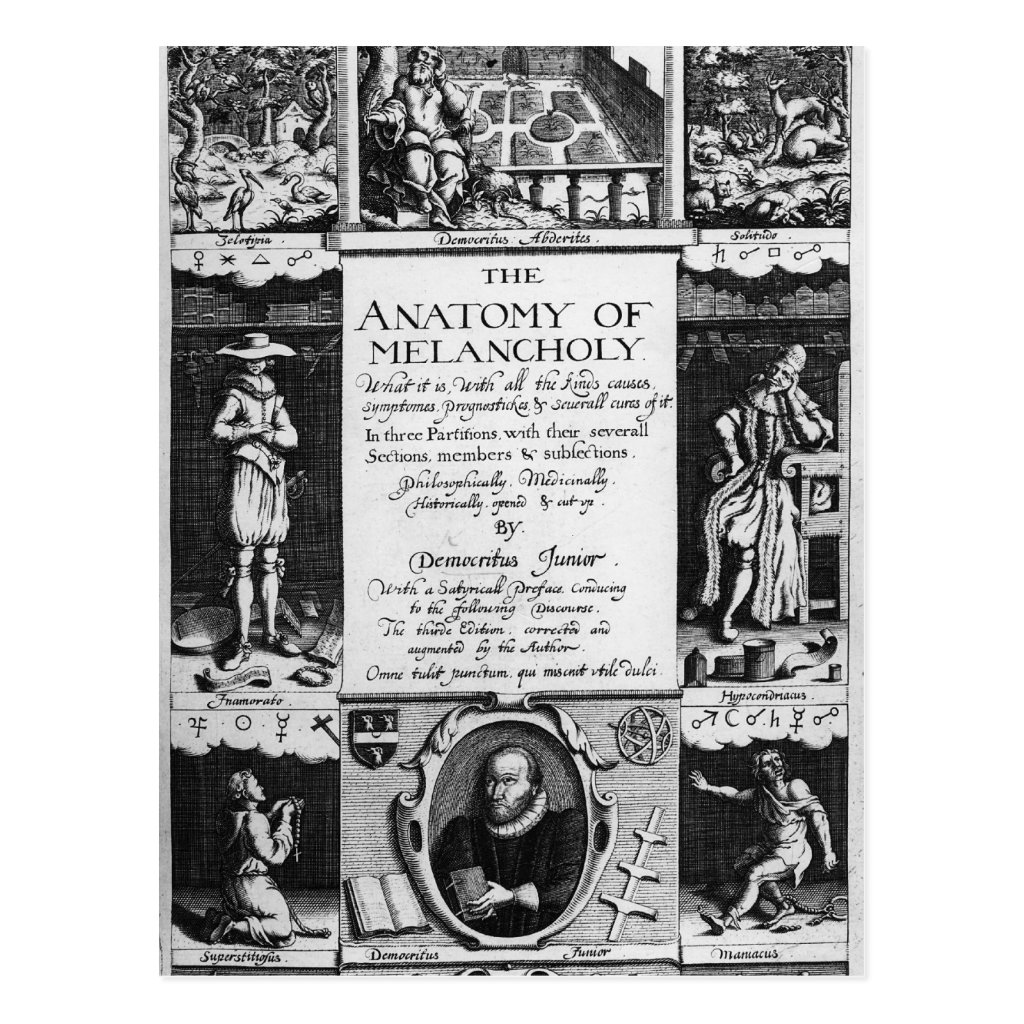
The Anatomy of Melancholy, What it is: With all the Kinds, Causes, Symptomes, Prognostickes, and Several Cures of it. In Three Maine Partitions with their several Sections, Members, and Subsections. Philosophically, Medicinally, Historically, Opened and Cut Up, to give the book it's full and glorious title, is by Robert Burton and was first published in 1621.


So what kind of book is it? Some doctors of the time considered it a medical text, and there are certainly plenty of references to Galen and Hippocrates, humoral theory, miasmas etc. Philosophers considered it philosophy and religious men saw it as a meditation upon something or other, possibly God, but possibly some humanist abstraction or other. But in my opinion they all got it wrong - it was the world's first piece of hypertext, Burton just had the misfortune to be writing it 350 years or more before the invention of the electronic doodad that might have enabled him to realise his scholarly ambition.


With its extensive buttressing of every point with quotes from ancient and modern authorities, it footnotes (and its footnotes to the footnotes ((and its footnotes to those) plus it's layered parentheses and convoluted sub-clauses (and sub-sub clauses))) it is a text just crying out for hyperlinks. To say it is digressive is like saying metonyms are synedochial. It attempts to cram the entirety of human negative emotion, all of it's possible causes, both within this universe and in the metaphysical beyond, plus all the possible treatments, proven, unproven and conjectural, physical and spiritual, between two bits of card and the prosaic medium of squished and dried wood pulp. Lots of squished woodpulp, 900 pages of it. One cure for melancholy I am sure Burton must have slipped into a footnote somewhere is being thumped upside the head with this very book.


It doesn't use a conventional contents page. It has a 'Synopsis' of it's 'Partitions', a division of the book into sections, sub sections etc. all mapped out in a diagram of parentheses, with extensive cross references. It is just crying out for a tabbed browsers and breadcrumb navigation, and the search function provided by the index is pathetic given the massive scope of the work.


You are most likely to know about this work through Laurence Sterne's Tristram Shandy, virtually a love letter to the work as well as a satire upon it. Sterne did not invent his incredibly elliptical style, he nicked it from Burton and actually toned it down for comic effect. But who was Robert Burton satirising? Did he mean these ramblings to be taken seriously? And who the hell was Burton anyway? Helpfully Burton devotes the first few score pages of his book to an allegorical autobiography of his alter ego and nom de plume 'Democritus', his frontispiece to a symbolist illustration of his life and hell, he even includes his astrological birth chart! What could be revealing than that?


This is a book about depression written by a self-confessed depressive, but it is anything but a miserable read. It is filled with an erudite dry wit and acute and humorous observation that anyone who has read Sterne or Rabelais will immediately appreciate.

And today this great work is almost forgotten, despite it being the favourite reading of literati, glitterati and cognoscenti as Keats, Samuel Johnson, Borges and Nick Cave.


You wanna read it too? Clicky here!

Audiobook version. Clicky here!

The Gamey Bits!

First published in 1621 this book is still famous and widely read in 1642 at the start of the English Civil War, though the sheer size of the volume limits it to the reasonably well off and the density of its subject matter to the very well educated. A bookseller in a city will have it for £2 10s new, half that for a second hand copy. Robert Burton died in 1640, hanging himself in his chambers in Christ Chruch, a bit of a mystery man to his end. People that knew him in Oxford say he was a shy, extremely scholarly type who smiled and laughed at nothing except the utterly profane swearing and cursing the barge men used on each other as they jostled under the bridge.


It takes at least two weeks reading the work as a full time study, and it is only possible to get the full depth with knowledge of Latin and Greek. For more casual reading roll 2d6+2 and subtract INt bonus to get the full effect. To anyone with Intelligence of 8 or under it is utterly impenetrable gobbledigook. It may be read as many times as you like, but on each reading roll d20 under Intelligence to get anything more from it, and when rolling below subtract 1 from the result for each previous reading.


Roll d6 on the table below, +1 if you know Latin, +1 if you know Greek, add Intelligence and Wisdom bonuses.


0 or less - No effect. Never managed to do more than skim the work, or if had read it before gained no new insight.


1 - What the hell was all that about? The circuitous bafflegab has rendered you temporarily abstracted. Lose 1d3 Intelligence, regaining one per week as you clear your mind by sinking back into shallow banality. Regain one point instantly for attending a Punch and Judy show, one of the really good ones with the crocodile and sossidges and savage beatings.

2 - 5 Err, yeah, great book... You have absorbed enough of the book to say that you have read it. You can impress the ignorant with your erudition, but will be immediately exposed as a shallow dilettante among those who actually have. Temporary +1 Cha in the right crowd, -1d6 in the wrong one.

6 Melancholy. If you have never suffered from melancholy before, you sure do now. Roll over your Wisdom on a d20 to avoid this effect. You suffer from lassitude, demoralisation and misery at the profound meaningless of life and general ickiness of mankind. Lose 1 point of Strength, Constitution and Dexterity. Save again at the end of the month or lose another point. Cures are alcoholism, suicide or conversion to Puritanism or Presbyterianism, or possibly reading the book again.

7 Cured of Melancholy. You have seen the light, or possibly just appreciated Burton's cock-eyed wit, and if you had Melancholy before you don't have it now. Recover any lost characteristic points from Melancholy and gain +2 on all saves vs mind affecting magic or effects for the next 1d6 weeks. Non-sufferers get +1 to saves for 1d3 weeks from general spiritual re-edification. Does not affect Puritans or Presbyterians; merely reading a book of jokes and quotes from Pagan philosophers now getting their just desserts toasting in HELLFIRE will NOT divert your soul from its predestined path. Try the BIBLE you fool!

8 Introversion. You lose 1d3 Charisma as you become as obsessed and pedantic as Burton about tracking each thought down to its authoritative source and muse pensively on the nature of life. You gain +1 intelligence from the same.

9 Humanitarian Expansiveness. Gain +1 Charisma and +1 Wisdom as the droll and peculiar insights provided by the work make you more tolerant of your fellow man and his mental infirmities.

10 or above. Interesting Insight. Gain 1d100 XP if a Fighter, 2d100 if a Specialist or 3d100 for a Cleric or Magic User, gain +1 Int or Wisdom. In addition Clerics and Magic Users may now use the book as a research work for creating new spells. It has a value of 75sp for most spells, and a value of 150sp for spells that affect the mind and psyche.


1 in 6 copies recovered will be damaged by having a cavity cut out of the pages. The thickness of the work makes it highly suitable for hiding a bottle of spirits.

Saturday, 30 May 2015

Abiezer Coppe

Another oddball wandering around in the English Civil war is Abiezer Coppe, the infamous Ranter prophet.

Reading about the Ranters today it is hard to believe such lunatics existed as long ago as the 17th century. They were extreme Antinomian anarchists, they believed that for the truly 'saved' there was no obligation to follow the laws of God or Man, that sin existed only in the imagination of men who wished to restrain God's spirit, not exalt it and that there was no such thing as private property for all belonged to God alone, and was free to use by the fiathful..

They drank and smoked tobacco immoderately (the nearest thing to dope they could get in 17th century England presumably), indulged in 'love feasts' full of serious drinking and casual sex and ran off without paying the bill, they allegedly stole, lied and cheated and were generally complete arseholes.

But there was a manic mysticism behind it all, a genuine feeling they had transcended the mundane Christianity of the Churches to become greater than Jesus himself, their personal wants one with those of the Godhead. Some even burned the Bible to demonstrate they had no need of it, and went around naked to show they abandoned absolutely all earthly goods.

Needless to say they got in serious trouble and the whole mad sect dissolved during the 1660's, variously converting to less deranged (but still pretty mystical) sects like the Quakers, ending up in jail or transported to the colonies, running off the the colonies before they got transported, and probably drinking, smoking and fornicating themselves to death.

They never had leaders, the whole concept was against everything they lounged louchely in the corner of a pub for, but one of the most famous today was Abiezer, as he left us some quite remarkable and pretty incomprehensible writings, most notably 'The Fiery Flying Roll' published in 1650.

As of 1642 Coppe is a young man of 23, not long 'graduated' from Oxford University (he kind of abandoned studying Divinity under such conventional church-bound bores, kind of got thrown out for being the worst kind of slack, argumentative and drunken student imaginable). He is making his way round England meeting the many extreme dissenting preachers of the many sub-sects and political movements beginning to emerge as the Civil War loosens and occasionally preaching his own brand of kooky salvation on street corners, crowds of drunks in taverns and at the odd Seeker meeting house and radical Congregationalist church.

This character was created using Marc Gacy's classess LotFP system from Undercroft #4, available from Daniel Sell at http://whatwouldconando.blogspot.co.uk/.

Abiezer Coppe, Laurence Clarkson, Prudence Hever and Sally Price live it up at the Lamb and Flag in Colchester


Abiezer Coppe

Age 23
Alignment: Neutral Cavalier
Religion: Ranter
Level 4

Cha 13 (+1) Con 15 (+1) Dex 11 Int 13 (+1) Wis 17 (+2) Str 8 (-1)
Saves: Pa: 11 Po: 11 BW: 15 MD: 13 Ma: 14
Sills: Stealth 3 Bushcraft 2 Climbing 2

Att + 1
Can cast Cleric spells at level 2
Languages: English, Latin

AC 13
HP 19

Buff Coat with 'poacher's pockets'
Felt hat
Tuck (d6 dam -1 to hit vs AC 15+)
Dagger
Purse with 3s 17d
Several rabbit snares, 1 in 3 chance of a rabbit
Someone else's mutton pie
Bottle of cheap wine
Pewter beer mug with engraving 'Property of Merton College'
A bent spoon, gift of a Jewish mystic he met while pissed as a newt in a pub in London
Hatchet
Heavily annotated Bible, with many crossings out, marginal comments like 'rubbish', 'Ezekiel was a dunce' and 'must use in next sermon'
Hastily scrawled sermon on back of a tavern bill of fare with numerous beer stains, lots of exclamation marks and underlinings of bits to be delivered in stentorian shout
Pipe
Pouch of tobacco
Twist of paper with willow bark for use as hangover cure
Letter from Laurence Clarkson, a fellow Ranter; contents partly theological, partly a good pub guide to the taverns of Essex
Key to the back door of the home of Mrs Prudence Hever of Colchester, an advocate of Free Love

Spells:
Level 1: Purify Food and Drink, Sanctuary

Abiezer is a tall, thin young man, usually sporting a couple days growth of beard and long, somewhat unkempt, hair, a shirt with a few small holes from stray wisps of burning tobacco and a hard used leather coat with patches on the elbows and voluminous pockets. There is little visually to distinguish him from any number of wandering labourers and runaway apprentices, such vagabonds are ten a penny, and he will often be found in the company of such.

He is better spoken than most (though he can put on a 'Mockney' fake working class accent when trying to pass unnoticed), and has a slightly mad twinkle in his eye and a tendency to use long words that don't entirely pass as proper English. His habit of addressing people as 'Fellow Creature' will suggest that he is some variety of religious oddball, and he never raises his hat to people of greater social status, a bit of casual rudeness that is a sure mark of a Leveller.

He may be met almost anywhere, but hiding in the woods from the law, preaching on a street corner with his pipe hanging out of his mouth and a mug of ale in his hand, and stuck in the town stocks for a day for being out of order or skipping church are all likely possibilities.

He stays in inns when he can (and leaves without paying when he can get away with it), but is also used to living rough. There are sympathisers all over the place - he is a frequent lodger at John Pordage's house when he is London (Pordage is an astrologer and pretty eccentric in his own right), and knows John Tradescant, Elias Ashmole and John Lilburne in that city. His uncle Tobias runs a printing press and a newspaper in Boston in Lincolnshire, and Abiezer sometimes wanders up that way. 

His current project is the formulation of a doctrine that will confound the most flinty Presbyterian busybody and make them realise that salvation through being a judgemental nosebleed and trying to get all to conform to their rules is against God's will as expressed through the desires of ordinary mortal men, not a path to salvation. He is also concerned about goings on in Essex - he took part in the looting of suspected Catholic gentlemen's houses there, but is concerned that the Puritan mobs have taken to witch-hunting as well. He is plotting the rescue of accused witches, taking the view that they are closer to God that many of their hide-bound accusers and are mostly innocents picked on for their difference and petty village squabbles.

Not Abiezer Coppe, just some other scruffy ranting loon

Monday, 25 May 2015

Rules I use

I use a few house rules for LotFP, not very consistently unfortunately, so for my benefit if no one elses I will try and codify what they are, and try and explain why.

Surprise

In an encounter where one side has quite definitely 'got the drop' on the other surprise is automatic and lasts one round. 

Unsuspecting party in a boat floating through apparently uninhabited marsh gets volley of arrows from a prepared ambush, a round of 'wtf, argh, where's my musket?' kerfuffle is fair enough.

In situations where one or both sides don't know what is going on, but are expecting something the whole party are surprised on a 1-2.

Party A sploshes through the swamps, party B knows they are out there thanks to successful listen rolls but don't know where. When they meet party A may be surprised, B won't be.

Initiative

PCs make an individual roll with Dex bonus, monsters get a roll per group. If there is a tie PCs get the benefit of the doubt for being protagonists and go first (they get precious few other breaks and saves time faffing with on the fly Dex rolls).

If you use a special action like Press or Parry the AC penalty or bonus lasts until your initiative tick next round.

Fumbles and Criticals

On a natural 1 you fumble and on a natural 20 you crit. I use the Compleat Arduin fumble and critical tables, except for firearms where I have my own table. Crits do normal weapon damage, but the special effects add further penalties and may kill outright.

Fancy combat moves

I am a great fan of the DCC feat dice and RQ6 combat effects, gets the players thinking about more than just the thud, bang, wallop of melee and how to get the upper hand. For LotFP any character may try this - roll a second d20 add your combat bonus, subtract the enemies and if you get 17+ you have pulled some fancy manouvre; blinding, tripping, pushing back, blocking etc. Opponents may get a save or characteristic roll to avoid it, if appropriate.

Damage and Death

Not been very consistent about this but will follow this procedure...

If you are down to below 0 HP you are not automatically dead, but you roll on the Crit Table to see what horrible injury has happened to you to put you down; this may be terminal, like being shot in the head, and may leave you with a permanent disability like missing fingers, limbs, ears, face mashed in and scarred etc. .

If you are not dead yet, your friends may save you. Save vs Paralysis with a modifier of how many HP you are below 0; make it, you live, fail, well, that's it...

Roll your Con or under; if you fail you permanently lose 1d3 points on STR, DEX or CON rolled randomly due to scarring.

You remain on negative HP, and if not outright unconscious, you will able to do nothing until healing has brought you back to positive HP; if by some miracle you survive a boulder being dropped on you from a great height, expect to spend a week in bed getting over it.

PCs will become increasingly battered and scarred, limping, eye-patched and hook-handed. If they wish to quit this adventuring malarkey as too much like hard work, they are free to.

Being beaten to a pulp and living to tell the tale in this way earns a +d100 XP bonus, for what it is worth. The experience isn't fun, but it will teach you what not to do next time.

Healing

Effects like broken arms, sprained ankles, dislocated shoulders etc, are healed when you reach full HP again.

A Cure Serious Wounds will remove such effects even if it does not restore the recipient to full HP, and can be used to reattach missing limbs and digits (if they have been recovered from the site of the carnage) and restore damaged eyes and ears if cast within a week.

Heal will induce the regrowth of lost limbs at a rate of 1d10% of lost part per week.

Clerical Services

The various churches and denominations are more than willing to provide healing magic to those who make donations, and may possibly be persuaded to do it for free for co-religionists who are obviously fighting the good fight. Basic costs are below, though these are subject to a wide variety of circumstantial modifiers, and the higher level ones will only be available from a very few preachers who will require a long journey to find. The Archbishop of Canterbury is himself only 11th level, most typical parish priests and Puritan preachers are level 1-5 (roll 2d4-3, min 1).

(using the 12 pence = 1 shilling, 20 shillings = 1 pound system of pre-decimal England)

Level 1
Bless - 1s plus 6d per level of cleric
Cure Light Wounds - £1
Detect Evil - £1

Level 2
Augury - £3
Delay Poison - £2

Level 3
Cure Disease - £10
Remove Curse - £50

Level 4
Cure Serious Wounds - £3 10s
Divination - £10 + £1 per caster level
Neutralize Poison - £10

Level 5
Commune - £150
Cure Critical Wounds - £6

Level 6
Heal - £100

For the devout Clerical scrolls may be sold. These may also take the from of specially blessed holy symbols which will provide one use of a spell when a specific prayer or verse from the Bible is spoken, rosaries or candles (for Catholics), blessed printed tracts with woodcuts (for Puritans) or other form of religious paraphenalia. The cost is level of spell x £30, far from cheap!

Magical Services

Witches, alchemists and other such dubious riff-raff can be found all over the place, though the devout frown on their odious practices and it may take a bit of careful inquiry to locate them and persuade them to help. Astrologers practice openly, and there are 'scholars' who will offer advice and opinions on magical matters.Some common services on offer are below, but any given magic user will only know some of the spells and have some of the equipment.

Spells may be bought from a few magicians. A magic users livelihood and reputation rests on his unique stock of arcane knowledge and most like to keep what they know secret for fear of setting up rivals. Basic cost is £25 per level of spell, including the cost of transcription into the recipients spell book. It is often cheaper to research it yourself.

Level 1
Potion of Charm Person - a perennial favourite, these 'love potions' may also take the form of charms or rituals to be used to attract the target. Cost £20.
Identify - £10 if the magic user has a suitable lab, usually only available to wealthy apothecaries and scholars.
Detect Magic - £1 10s

Level 2
Light, Continual - 5s (note that these only last one day from time of purchase)
Magic Mouth - £10

Level 3
Dispel Magic - £10 plus expenses if travel required to magical site