Sunday, 29 May 2016

The Book-women of Westminster

If you wanted a book in the mid 17th century London there were plenty of bookshops and wandering chapmen walked the streets with pamphlets and broadsheets with the latest news, ballads and the polemical writings of the many political and religious activists in the city.

But some of the best were found in the heart of government itself, right in Westminster Hall in booths set up between the law courts.


Westminster Hall in the 18th century


Westminster Hall was built in 1097, a huge space 240 feet long and 67 wide, as an audience chamber for the King. He had his seat and table at one end and, surrounded by courtiers, he conducted the business of the realm, dispensed justice and indulged in a little pageantry and some colossal feasts.

But by the 17th century it had been taken over by the law courts. The King lived up the road in Whitehall with the Banqueting House as his public dining and audience room. The southern end was the Court of the King’s Bench, though the last King to sit personally in judgement here was Richard III and the King’s chair and table had long since been removed. The northern end was divided between the Court of Chancery and the Court of Common Pleas. In medieval times these had been temporary (in case the King wanted a really, really big feast) but by the 17th century there were permanent wooden partitions and benches, and the centre of the hall, warmed by a huge open fire, was a throng of lawyers, court officials, litigants and spectators.

These included the ‘men of straw’, people who went around with straw poking out of their shoes to indicate that for a suitable fee they would testify on behalf of anyone. Since the floor of the hall was liberally sprinkled with straw by way of a carpet they could easily claim that they had picked it up by accident.

Between the courts were 48 booths about eight feet wide with wooden walls and open fronts. These were shops selling all kinds of things to the crowds of lawyers. These included ribbons and cloth, Samuel Pepys bought his gloves here in the 1660’s and caps, as well as refreshments such as pies and ale. But the bookshops, mostly run by women, were most common.

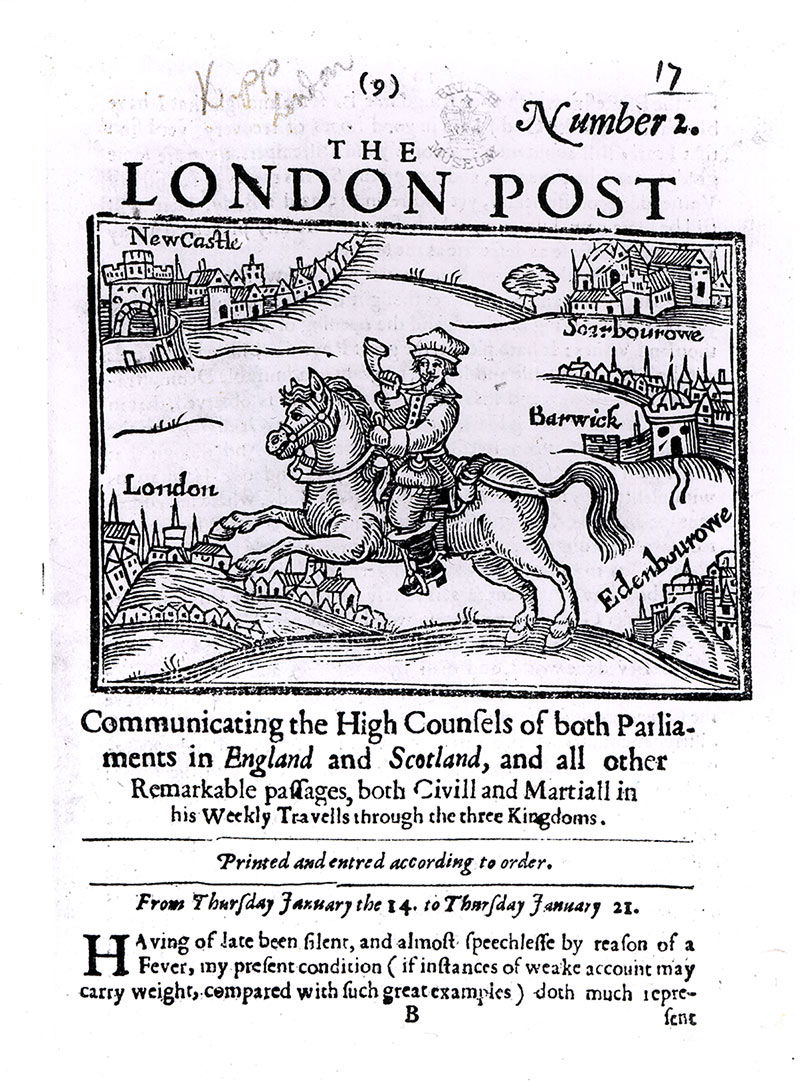
They sell law books; Coke’s ‘Institutes of the laws of England’, parts I and II, are very popular, and pamphlets published by the rebellious Parliament in their propaganda war with the King such as the ‘Petition of Right’ and the ‘Grand Remonstrance’ as well as unofficial write-ups of debates, and news sheets like the ‘Moderate Intelligencer’ and the ‘Mercurius Britannicus’ but you can find oddments of everything here.


Read allaboutit!

Mary Villiers the Mercury-woman

Mary has the best stock of news sheets, and even sells Royalist publications right in the heart of Parliament, being devoted to the principle of free speech. When the Court of High Commission which enforced Royal censorship and the licensing of printing presses by the Worshipful Company of Stationers and Newspaper-makers was abolished in 1641 any political or religious crank could print whatever he liked and in 1642 her stall is weighed down with hundreds of polemical tracts from the writing of John Lilburne to the withering critiques of modern morals of William Prynne. After June 1643 Parliament reintroduced censorship with the Ordinance on the Regulation of Printing, her stock falls off and she keeps the most scurrilous ones under the counter.

Mary practically worships the ground
John Lilburne walks on, he is her hero for standing up for the Freeborn Rights of the common people and has plenty to say about the corrupt judges of the surrounding courts, pointing out especially rotten ones as they wander through the hall in front of her. She has incited young and idealistic lawyers into starting fights with the more notorious ‘straw-men’, and she is a personal friend of Richard Overton, who writes and prints pungent satires and Leveller polemics under the pseudonym ‘Martin Marpriest’, and can arrange a meeting if her trust can be gained.


‘Lady’ Harriet Marples

Harriet is the widow of a barrister and a gentlewoman and deals mainly in law books. The most senior lawyers and judges nod to her in passing and to pick up the latest parliamentary proceedings, and she has a young law student, Elias Withering, working for her who can be hired to make transcripts of anything going on in the Palace of Westminster. It is alleged she can even get him admitted to the most private committee chambers, for good customer willing to stump up the fee.

She is also well informed as to the best and most plausible straw-men for lawyers in danger of losing a case due to lack of decent real witnesses, has a couple of burly footmen who are willing to ‘persuade’ jurors on the quiet, and even a pet MP or two whose votes are for hire, though quite what she has on them is anyone’s guess. She is always interested in gossip about the members to add to her stable, and will have work for glib and presentable adventurers who don’t mind a little perjury or running shady errands in the back passages of the Palace.

Her apparently well thumbed copy of Coke’s Institutes has a cavity cut out containing a small bottle of cheap gin and she keeps a bottle or two of wine and some glasses at the back of the booth to toast the success of her protoge lawyers. If you want a sensible conversation catch her before two in the afternoon.

Cecily Jones the Lambeth Witch

Cecily comes across the river from Lambeth to the Westminster Stairs every day in her son’s ferry boat and is looked down on by many for being from ‘South of the River’. She doesn’t just sell books but pipes and tobacco as well, and many suspect it is contraband. She dresses like a Puritan but talks like a fishwife, and if she falls out with a customer she will wave a dagger and threaten to cut out their liver in Old Palace Yard.

Her speciality is books on the occult, ostensibly written by various churchmen by way of a warning against witchcraft, but containing a good many true details about the proper casting of magic. She openly offers to draw up astrological charts to predict the outcome of cases and if asked nicely by the right kind of customer will invite them over to her house where she will cast curses on witnesses, lawyers and judges in order to get a good outcome, and maybe brew the odd potion. She is pretty deft with her knife and will collect samples of hair and snippets of clothing just wandering through the crowds in the Hall.

She does have some sense of justice and feels it needs a bit of help from time to time to get past the inconveniences of the actual law and it’s practitioners. Her favourite stunt is to cook up some of Dr Chiffinch’s Spike from Skull Moss (see
Undercroft issue 9) and use it on a straw man just before he takes the stand, forcing him to tell the actual truth.


Possible occurrences in Westminster Hall

  • King’s Bench and Common Pleas are at it again. With the Chief Justice of the Common Pleas Sir John Bankes buggering off to join the King in the north, Robert Heath, Chief Justice of the King’s Bench has been snaffling lucrative cases from the rival court. Tobias Chelmsley, Common Pleas’ Chirographer got into a fight with Elijah Plunkett, a King’s Bench Notary, after Plunkett tried to bribe him to let him amend some fines in his court roll. Chelmsly’s fingers were broken in the scuffle and the two court’s corps of Ushers eye each other across the floor of the hall, an ink bottle was thrown and the sound of furious quill sharpening can be heard all around. A battle or Writs will no doubt ensue.
  • Sir William Monson, lawyer, MP for Reigate and a member of Gray’s Inn, has marital troubles. The whisper going round the Hall is that his wife and her maids overpowered him and tied him naked to a bedpost and whipped him for being against the King. Various wags keep offering a seat.
  • Elias Withering, Harriet Marple’s creature, has not been seen for a few days. Someone thinks they saw what might be his left ear nailed to a post on London Bridge.
  • James Hopkins, a Suffolk clergyman, and his son Matthew are perusing the books on Cecily Jones’ stall with a lively interest and making notes as to the authors. What are they up to?
  • Mary Villiers has been done. She took fifteen copies of Abiezer Coppe’s sermon ‘Godde’s Mightie Erucation; or the Right Methode of Skinning a Cony’ and can’t shift them since they are heretical jabbering nonsense of the first water. You can pick one up for tuppence or find the printer for her and force him into a belated sale or return deal.
  • A monkey (or was it a demon?) has been seen clambering among the hammer-beams up in the Hall’s magnificent medieval roof. A witness says it had a spyglass and hat with a panache.
  • Newgate Prison leaks like a sieve. The Keeper of the Prison has been dragged down to Mary Villiers stall by a committee of MPs to be shown how many pamphlets are being written by inmates he is supposed to have banged up. Has he not noticed the wagon loads of ink these rascals must be having delivered? How are they doing it?

Thursday, 26 May 2016

England is Upturned

England Upturn'd is now out, and you can buy it from Lamentations of the Flame Princess HERE for the very reasonable sum of 16.50 Euros (that's £12.59 or $18.47), and the PDF should be up on RPG Now and Drive-Thru RPG at some point as well.


Crappy screenshot of cover, it looks nicer than this.


I will be running it at the UK Games Expo at the Birmingham NEC on Saturday 4th June at 3pm. You will find the event some place on this page HERE. (I know I really ought to be doing it several times to try and promote it, but it was all kind of last minute and I'm lucky to get a slot at all).

I have also been interviewed HERE. Ignore the pic, I haven't looked like that (or been that stoned) for at least 25 years.

James Malisewski also has a new LotFP release, The Cursed Chateau. James has been suffering me and a bunch of other loonies randomly blithering across Tekumel ignoring all his best laid plans for over a year now and shows no signs of giving up yet, a very patient DM and very understanding of my PC Znayashu's preposterous plans for numerological terror and discalculic mayhem.

And a huge thank you to all those who helped in the playtesting for England Upturn'd; now you can read the thing and find out what the hell was really going on. And no, your chances of survival were always going to be slim...

Further English Civil War related malarkey will be appearing on this blog from time to time and in Daniel Sell's Undercroft zine (HERE). I have such a post brewing in fact, just need to get my head round Enochian angelology. Any suggestions as to anything of that ilk you'd like to see will be much appreciated.

All this blatant self -promotion is acutely embarrassing. Just want to crawl back under my pile of history books and watch Hollow Crown on iPlayer.

Edit: A review already! At Swords and Stitchery. Thanks Eric!

Monday, 29 February 2016

Daniel Axtell: Bastard at Large

Daniel Axtell was a Puritan and one of the few outright fanatics in the Parliamentarian Army.

He started out as a 'Particular' Baptist, a fairly hard-line sect who believed in: 

  • 'Separatism' - ie quitting the Church of England in favour of being an independent church
  • Strict separation of Church and State - no official CofE at all, and certainly not having the King exercise any religious authority
  • 'Particular' salvation - that predestination meant that salvation was not for all, only the elect would be chosen for heaven as opposed to the slightly more easygoing 'general' Baptists who at least believed in free will and achievement of salvation through one's own efforts and being thoroughly dunked in water
He was a London apprentice and joined the Parliamentarian army in 1643 at the age of 21, at first in John Pickering's regiment of foot, one of the highly effective Eastern Association units which became John Hewson's regiment after Pickering's death in 1645 and one of the core units of the New Model Army. He served at the siege of London in May 1644 and at Marston Moor later that year and in plenty of other skirmishes besides.

He served with distinction in Kent putting down the Royalist uprising there as part of the Second Civil War, and was one of the officers who held down the London mob during Pride's Purge, when the army threw out all the moderate MPs likely to vote against the execution of Charles.

He was commander of the guards at Charles' trial and threatened to shoot Lady Fairfax for interrupting the trial and was later accused of coaching his men to disrupt the trial himself with cries of 'justice' and 'execution' and of being rude to the King.

Axtell was also a preacher, and since in the 1640's preachers still had to be licensed by the church this meant turfing a priest out of his pulpit and giving vent to his own hellfire and damnation brand of Baptism. He became a Fifth Monarchist, a small sect of outright fanatics who believed that the Civil Wars were the prelude to the second coming of Jesus in 1666 and that they would be the saints who would rule a thousand years under his divine kingship.

He was a Major during the invasion of Ireland and was the man mostly responsible for starting the massacre of Drogheda, persuading the Royalist commander Aston to surrender and, after he and his men had laid down their arms, shooting the lot of them. Aston was beaten to death with his own wooden leg by men of Axtell's regiment and their cries of 'no quarter' were taken up by troops all over the town.

He was court martialled by Henry Ireton after doing the same on an even larger scale after the Battle of Meelick Island on the River Shannon, and was captured by Royalist privateers on his way back to England and held on the Isles of Scilly. He was lucky not have been hung by Irish troops in the Scilly garrison.

After being freed he returned to Ireland as governor of Kilkenny, Ireton having died of dysentery in the meantime - no doubt the judgement of God in Axtell's mind for challenging his methods - and led a reign of terror there until he clashed with Henry Cromwell, the new Lord Deputy there under the regime of his father, Lord Protector Oliver Cromwell. Henry tried to be conciliatory to the Irish and to expel the extreme Baptist officers who had come to Ireland under the previous Deputy Fleetwood and who were among the worst oppressors of the long suffering civilian population.

A Republican die hard to the very end, Axtell took up arms against the restoration of Charles II, but was captured and eventually hung drawn and quartered in 1660 for his part in the execution of Charles I, his 'I was only following orders' defence doing him absolutely no good. From the scaffold he declared his loyalty to the Good Old Cause and prayed that Charles II would convert to a Godly way of life.


In 1643 Axtell is young ensign of 21, sporting the cropped haircut of a London apprentice that earned the Parliamentarians the nickname of 'Roundhead' and looking like a street thug stuffed into a uniform, which is what he essentially is. But he is a very religious thug, never using actual curse words and backing up his sneering condemnation of the Royalists and gentry with Biblical quotations, especially from the Book of Revelation. He is very sure of himself, he is of the elect earmarked for a place in heaven and he knows it, and he is a stern disciplinarian, never letting an opportunity to berate his men for drinking, swearing and slacking in their drill pass him by. Fortunately many of them are pretty religious themselves and those who aren't are itching to get assigned to another company.

He doesn't like his captain, a gentleman slacker in Axtell's opinion, who lack of fervour in his prayers will get him a bullet out on the battlefield. Sure enough he gets one in an engagement in mid-1643 resulting in Axtell's promotion and in the confusion no one seem to notice it was in his back...

Daniel Axtell
Age: 21
Alignment: Republican Roundhead
Religion: Puritan
Level 2

Cha 13 (+1) Con 15 (+1) Dex 9 Int 12 Wis 12 Str 16 (+2)
Saves: Pa: 13 Po: 13 BW: 16 MD: 14 Ma: 15

Att +2
Can use Defend and Press

Cleric spellcasting level 1: Spells 1 Praise the Lord and Keep Your Powder Dry
Languages: English

AC 16
HP 14

Buff coat
Sash in regimental colours
Lobster-tail helm
Pikeman's armour

Sword (d8)
Brass knuckles, engraved with the message 'From a loving Mother to her Prince of Peace'
Matchlock musket with three crosses scratched on the stock for Royalists shot, room for plenty more

Musket stand
Bandoleer of 12 apostles, plus a thirteenth marked JC for Jesus; Axtell's 'lucky' bullet

Powder horn
Bag of 20 shot
Spare matchcord
Purse with 1s 8d
Normal clothing
Whistle
Pocket Bible

Plain wooden cross on piece of hemp
Stern letter from his father exhorting him to Godly behaviour
Page torn from a chap-book bearing a woodcut of King Charles and the message (in Axtell's handwriting) 'Yore ENNEMY'; will be pinned to a tent pole or wall whenever Axtell's unit are encamped


Sunday, 7 February 2016

Freeborn John

John Lilburne was a Leveller agitator and was for brief spell in 1647 the most dangerous man in England.

The Levellers were a potentially revolutionary group who emerged from the political/religious campaigners who objected to the arbitrary rule of King Charles and the heavy handed religious authority of Archbishop Laud. They stood for votes for all (all men anyway, but still pretty radical for the 17th century), freedom of speech, freedom of worship, free trade and free whatever else. They did not go as far as the Diggers, who were communists who held that all property should be held in common, but they were radical enough.

John was born in Sunderland in 1615 and was born one of the awkward squad as his father had been the last man to insist on trial by combat over some obscure court case with Ralf Claxton, and was only stopped by order of the King himself.

He was a friend of John Bastwick, one of the three Puritan pamphleteers who got their ears cut off and branded by order of Archbishop Laud in 1637 for preaching against bishops. John got caught up in this case for actually printing the words of the mutilated men and was forced to flee to the United Provinces. But he returned pretty quickly and was taken to the notorious Court of Star Chamber on a charge of unlicensed printing.

He refused to recognise the authority of the much hated court and refused to take the oath. He was flogged and even while stuck in the Westminster pillory he defied the censors, making speeches to passers by and somehow managing to spread yet more unlicensed and inflammatory pamphlets. He was gagged and taken back to Fleet prison for another good kicking, but his fame amongst opponents of the regime was assured – he was 'Freeborn John', the man who would just not shut up and bow his head to the tyrannical King, and some supporters even struck a medal in his honour.

In 1642 he joined the Parliamentarian army as a captain and fought at Edgehill, but was captured at the battle of Brentford. The Royalists threatened to put this notorious gadfly on trial for treason but Parliament warned that if they started to execute prisoners of war they would do the same. He was returned to his comrades through a prisoner exchange.

During army service he became a friend of Cromwell as both had fallen out with the Earl of Manchester and had a low opinion of his generalship. However he then fell out with the entire army in 1644 over the Solemn League and Covenant which committed them to imposing Presbyterianism on England in return for the military support of the Scots Covenanters. And in the meantime he had also argued with his old earless colleagues Bastwick, Prynne and Burton, and the MPs who had made sure he got his freedom in the early days of the Long Parliament.

By 1646 he had become such a pain in the arse he was locked up by Parliament in the Tower of London, and true to form he kept up his polemics from behind bars rising even further in the estimation of the London mobs who were becoming disenchanted with the by now Rump Parliament.

He helped write An Agreement of the People, the Leveller manifesto and while out on bail took part in the mutiny of the New Model Army at Corkbush Field. He organised the Levellers as a political party, elected 'agitators' among the London apprentices and spoke to huge gatherings of supporters. He ended up behind bars again for sedition. Released again in the hope he would help impeach Cromwell he, as usual, took his own line, trying to get the NMA to accept the Agreement as a constitution before putting the King on trial. He refused to sit as part of the court that tried Charles as without constitutional authority it was a mere kangaroo court that ruled by might, not right.


His later career was a mish-mash of trials, another stint in exile and general chaos, characterised by his spirited personal defences in court. He seems to have tried to give up politics and become a soap-maker (possibly so he had a ready supply of boxes to stand on), but his big gob and large opinions continually dragged him back into the fray, and the last years of his life were spent more or less permanently locked up in Dover Castle. He finally converted to Quakerism and in his last pamphlet said he was giving up politics for good. He died of a fever aged 42 in 1657. An obituary supplied this epitaph -

Is John departed, and is Lilburne gone! 

Farewell to Lilburne, and farewell to John...
But lay John here, lay Lilburne here about,
For if they ever meet they will fall out.

His lasting contribution to politics was the idea of 'freeborn rights', rights that you are born with, not granted by a government but by God, and since he was a passionate advocate of freedom of religion he didn't give much of a hoot which version of God you worshipped. The 'unalienable rights' of the US constitution and the 'human rights' of many a modern charter are the direct descendants of this idea, and Lilburne's defences have even been quoted in US courts in cases relating to freedom of speech.


What have the Romans - err King - uh Parliament - ever done fer us!


As of 1642 John is 27 years old, a captain in Lord Brooke's regiment of foot. He is well known among political activists, especially those in London, as Freeborn John, and by his superior officers as a barrack room lawyer of the most irritating kind. He does insist that proper military discipline and fighting the king with all your might is the only way to see common men like us get a fair crack of the whip in a future egalitarian England, and his men think he is great and have taken to reading the kind of inflammatory pamphlet he distributes among the regiment.

This character was created using Marc Gacy's classless LotFP system from Undercroft #4, available from Daniel Sell at http://whatwouldconando.blogspot.co.uk/.

John Lilburne
Age: 27
Alignment: Republican Cavalier
Religion: Leveller
Level 3

Cha 18 (+3) Con 11 Dex 11 Int 15 (+1) Wis 8 (-1) Str 14 (+1)
Saves: Pa: 13 Po: 12 BW: 15 MD: 13 Ma: 14
Skills: Lawyer 2

Att +3
Can use Defend and Press
Languages: English, Dutch, a smattering of legal terms in Latin and Norman French

AC 16
HP 18

Buff coat
Sash in regimental colours
Morion
Pikeman's armour
Sword with basket hilt (d8, plus cestus for 1d3)
Flintlock pistol
Powder horn
Bag of 20 shot
Purse with 12s 10d
Normal clothing x2, sewing kit
Spare set of boots
Whistle
Ink, paper, 2d3 letters to/from people he is currently arguing with and one to/from his wife.
Copy of 'News from Ipswich' by William Prynne
Copy of 'Institutes of the Lawes of England', second part, by Sir Edward Coke
Copy of 'The Letanie of Dr John Bastwicke'
1d12 misc. subversive literature and news sheets
Pocket book with detailed accounts of pay for each of his soldiers and himself down to the last farthing, current arrears heavily underlined. Also list of infractions of standing orders and military regulations by superior officers.

Saturday, 19 December 2015

Christmas Was Killed at Naseby Fight

After the English Civil war was over, the Puritans were in charge, a 'godly government' that would do their damnedest to follow the bible and reform the morals of the country. They were the closest thing the English ever got to the Taliban and their most infamous act was allegedly banning Christmas, and a lot else besides.


From 'The Vindication of Christmas', pub 1653

Cromwell woz framed!


Cromwell actually had little to do with the ban, it was the work of the Puritan dominated parliament and started while Cromwell had far better things to be doing, like charging about with his Ironsides beating the crap out of Cavaliers.

In 1643 the Rump Parliament decided that all traditional feasts were to be cancelled and that instead there would be monthly 'Thanksgivings', fast days held on the last Wednesday of each month. In 1644 Christmas coincided with the fast day for December, and no, they were not going to let up on the prescribed 24 hour starvation. Indeed the fast was to be celebrated -

With the more solemn humiliation because it may call to remembrance our sins, and the sins of our forefathers who have turned this Feast, pretending the memory of Christ, into an extreme forgetfulness of him, by giving liberty to carnal and sensual delights...

In 1647 Christmas was banned outright. Every Christmas was to be a fast day whether it coincided with a Thanksgiving or not and it was enforced by soldiers going house to house just before dinnertime and confiscating any meat they found cooking there. Troops also made sure all shops and businesses were open and that they were not forced to close by violent protest, since the measures had created a new Christmas tradition – rioting!

But even then they were just catching up with the Presbyterian Scottish Kirk who had banned Christmas back in 1640, and while the Restoration of Charles II in 1660 brought the festival back in England, Massachusetts kept the ban going until 1681 and it wasn't repealed in Scotland until 1686.

And why did they ban it? Because they found nothing in the Bible to say that the day should be celebrated, and were good enough scholars to know that the traditions were pagan in origin. They also banned it because the Catholics liked it; the recusant gentry pretty much gave themselves away with the magnificence of their Christmas celebration in Elizabethan and Jacobean times. Christmas was unbiblical, popish and pagan all at once, as far as the Puritans were concerned it HAD to go.

The Puritan Revolution - 'If in doubt DON'T'

The Puritan zeal to reform all that was reformable knew no bounds. Once King Charles was dead it was year zero of a new godly age, and the people of the British Isles were in for a rough ride.

In 1650 the death sentence was introduced for adultery, though English juries were sensible enough not to find many people guilty, even less to hang them. Only three or perhaps four cases of this cruel law being carried out can be found for the ten years it was theoretically in force.

Trying to stop the English (of all people) from getting drunk and swearing were also a dismal failures. In fact it became a matter of pride among some men to be had up in front of the magistrates for drinking as many times as possible. The Major-Generals did manage to close a lot of allegedly 'excess' alehouses in 1655, but when their rule ended the next year they all just opened up again. Some magistrates took the swearing ban very seriously, fining people or sticking them in the stocks for saying 'Upon my life'. But mostly people just told the government to fuck right off.

There were bans on bear baiting, cockfighting, long hair and wigs, fancy clothes, make-up, playhouses, working on the Sabbath etc. but most extreme example though was when one worthy MP suggested in debate that they should stop people from leaning

With sod all else to do on a Sunday thanks to the ban on work, ban on all games and shutting the alehouses people ended up sitting on the doorsteps of their houses on a Sunday shooting the bull. This gentleman observed that idly sitting gossiping could not be a sanctification of the Lord's day; a colleague wanted to go further, saying 'Some persons have not the conveniency to sit at doors, so I would have you add some to it, viz. leaning or standing at doors'.

This measure only failed by two votes.

As a Royalist ballad of the time said:

To conclude, I'll tell you news that's right,
Christmas was killed at Naseby fight:
Charity was slain at the same time,
Jack Tell-truth at that same time,
Likewise then did die,
Roast beef and shred pie,
Pig, Goose and Capon no quarter found. 

Yet let's be content and the times lament,
You see the world turned upside down.

A ballad of 1660 when English normality had been restored with a vengeance.


Saturday, 5 December 2015

King James' Submarine

Cornelis Jacobszoon Drebbel is a long forgotten engineering pioneer. He worked amongst the ferment of new ideas and new technologies of early 17th Europe and like many clever men of the time was a bit of a showman – you had to be to attract the necessary funds from Princes and Kings – and touted his ideas around the courts of Europe.

And Cornelis travelling engineering show was pretty impressive; he developed, among other things; a thermostat, a solar energy system, special effects for masques such as rain, lightning and thunder, worked on drainage and water supply in Germany and in England, made an automatic lens grinding machine, a solar powered harpsichord, invented the first microscope, made exploding glass 'Batavian Tears' and designed a detonator that used them to set off torpedoes and sea-mines, and then went on to create fulminate of Mercury.

But his piece de resistance was the submarine...

Drebbel's Underwater Rowboat


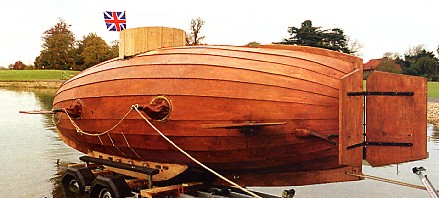
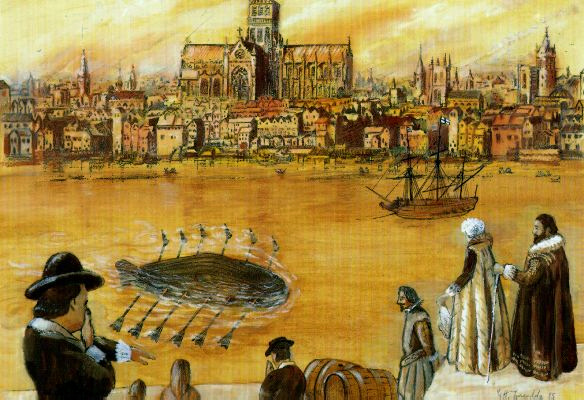
In 1620 he managed to interest King James I and VI of England and Scotland in a radical new boat for his Royal Navy. Starting from the 1578 design by William Bourne he created a leather covered, wooden framed boat that could be rowed underwater. Over the next few years he created two more, finally coming up with a veritable submarine galleon, a six oared vessel that carried 16 passengers.

And this was not just some Leonardo-ish doodling on plans that never came to pass either, he built it and had it rowed for three hours 12 feet under the water, up and down the Thames between Westminster and Greenwich before an astonished King and thousands of his subjects.

But unfortunately the Admiralty didn't like the idea and it never saw use in combat.


Modern engineers have suspected that Drebbel's device was in fact more hype than substance, but a modern reconstruction (extrapolated from descriptions and pictures admittedly) built of the BBC 'Building the Impossible' series did actually work.

The Truth


Any, all or none of the following explanations may be true...
  • Drebbel actually did it. The device works thanks to his talent for alchemy; one diarist says he made a 'chymicall liquor' kept in a stoppered flask which would 'speedily restore the troubled air'. This is potassium nitrate, and by heating it Drebbel could create oxygen. The records don't actually record this, but the boat was destroyed due to this device – an able seaman lit a pipe when the boat had been underwater for a couple of hours and Drebbel's oxygenator had enriched the carbon dioxide laden atmosphere with plenty of fresh oxygen. The boat caught fire 15 feet down, the crew were overcome by smoke and died trying to escape.

    LotFP Watercraft:
    Submersible

    Required Crew: 4, Miles per day: Sailing 12, Rowing 12, Cargo 0.5, Ship Hit Points: 3

    The ship has a small mast and sail which can be raised when on the surface, not that it is very effective. Once it has taken 1 damage it will begin to flood and will sink to the bottom in 10+1d10 rounds unless it surfaces. If it takes 2 damage while underwater it cannot surface and will hit the bottom in 1d10 rounds. Escaping from the ship while underwater isn't easy. Highest DEX passenger goes first and makes a save vs Paralysis plus their Dex bonus to get out. Only one person may attempt to escape per round, and each round they are stuck in the flooding and sinking boat they get a penalty of -1 to the save. Once it has 'sunk' it is full of water and all aboard will drown.

    Can sail for a maximum of three hours underwater, each hours submerged travel costing 5sp in chemicals for the air recycling rig.

    Making such a boat will cost 3000sp, or £150, but can be done by an ordinary boatyard.
  • Drebbel's boat was crap. It couldn't submerge totally, you needed to keep the hatch of the 'conning tower' open so the crew could breathe and it was appallingly easily swamped unless the water was completely calm. The ship still exists at the King's boathouse in Westminster, but it will need repairs.
  • Drebbel was a sorcerer. The boat did indeed work but only because the cunning swine utilised a temporary magic portal to another world to refresh the atmosphere inside the vessel. On one test the 'atmospheric portal' did not open onto the refreshing sea breezes of Theta Reticuli VI, but onto the soupy and miasmic lower clouds of a gas giant, killing all in the boat. There is a pond in a secret location in Herefordshire covered by a sealed dome where the still open portal pumps toxic oily fumes into the water and years later pollutes the air above it. Natural philosophers and engineers seek a way of closing it, but some horrible floating betentacled things got in through the portal and are making it difficult.
  • Drebbel was a pretty evil sorcerer. The boat worked because he had surgically adapted the crew to underwater rowing by grafting gills onto them. When the program ended the crew were left to fend for themselves and currently live in a cave under Lake Windemere in Cumbria. One of their number has ventured ashore though – he wants a woman to be changed to be his companion and seeks to find Drebbel's arcane surgical manuals and to woo – or even kidnap – a suitable convert.
  • Drebbel was a pretty smart sorcerer. He didn't just invent a submersible boat he invented an invisible one and told everyone it was a submersible to throw off spies and rivals. and avoid having people inquire to deeply into the quite diabolic magic he employed. The whole thing operates thanks to an invisible amoeba-like demon that swallows the boat, scoots it down river then vomits it up. Drebbel uses various substances to coat the boat to avoid it being digested and electrical discharges to get it out of the demon at the destination. Hopefully.

    The demon is still about, Drebbel set it loose in the Cambridgeshire fens where it was supposed to help with the drainage project he had going there. It's gone a bit wild in the intervening years though, might not respond to well to the magic dog-whistle Drebbel made to call it.
  • Drebbel got too ambitious. He found a way of miniaturising his submarine and its crew and when King James fell ill in March 1625 sent them on a mission into the King's brain to repair the damage caused by a stroke. Sadly the miniaturisation magic wore off too quickly making quite a mess. A waxwork of the King's head was fashioned for the lying in state part of his funeral.
  • Drebbel's boats were taken seriously by the Admiralty, but King James was too canny to let on, and development continued in secret. During the current civil war Parliament may be very pleased with themselves for subverting the entire Royal Navy, but just wait until the secret submersible squadron, powered by Drebbel's Perpetuum Mobile engine, are unleashed. They have already ferried Queen Henrietta Maria secretly across the channel and are bringing arms in from the Netherlands. Once the nefarious splintering glass torpedoes are perfected those treacherous and mutinous bastards in the surface fleet will be sent to the deeps!

Tuesday, 20 October 2015

The Moon Lens

The Moon Lens is a discus shaped object twelve inches in diameter and a kilogram in weight. It is mainly made of a porous and crumbly grey rock, pitted in places and scorched black and melted in others with radial striations carved on one side. It has a copper coloured metal band round the circumference with engraved symbols. In the centre of the disc is a cylinder of quartz about an inch wide running through it, though its internal fractures and some cloudy patches make it impossible to see all the way through clearly. It can be thrown, but it is unwieldy and hard to aim.


The writing is in the Cretan Linear A alphabet and encodes four magic words which can be used by the last person to hold the object. There are a few other symbols, some obvious depictions of stars and of phases of the moon, other more obscure.

'Urnentu' makes the object temporarily weigh just a few milligrams. It can be thrown a quite ridiculous distance while in this state. A man with 18 strength and good discus technique could throw it into a low orbit.

'Gertu' will return the object's weight and bring it back from orbit to the user. It will scream down from the sky as a meteorite would and will thump into the ground with considerable force. It will be incredibly hot from re-entry and will take a good four hours to cool. It will hit somewhere within sixty feet of the user and if it hits a structure in that area the structure will suffer severe damage. If it falls into water it will sink in a gout of steam and will need recovery from the bottom. It was not designed to float and there is a 50% chance that the thing will crack from its too sudden cooling and become useless if it hist cold water. The Moon Lens will not return if it is on the ground, the word will merely make it heavy once again.

'Irki' will cause a light to shine from within the quartz, focussed in a narrow cone that is maybe an centimetre wide at a distance of ten feet. It is barely detectable at twenty feet as it is not very bright.

'Bidtuko' will make anything fully enclosed by the cone of light on the striated side teleport to any surface touched by the cone of light on the other, plain side, moving instantaneously. You have to be two hundred miles away to have a cone wide enough for a human to be so transported, and the effect works in straight lines only – the curvature of the earth is not taken into account by the device, so it has to be well above the horizon on the peak of a very tall mountain and will shoot the user somewhere into the depths of space. Transport is one way unless the user find some cunning way to turn the disc over while it is hundreds of miles away in the depths of space.

Using Comprehend Languages on these words will tell you their meanings – Furthest, Closest, Open and Travel – but not how to pronounce them and thus activate the magic. That will take the recovery of some Cretan inscriptions in both Linear A and B and a ferocious amount of linguistic knowledge to work out the sound values of each letter; the logograms between these magic words will remain undecipherable by any means. The language may be recognised as a remote ancestor of Basque.

The lens was made by an ancient civilisation who had somehow fallen out with the Selenites and wanted to invade the moon. With knowledge of Newton's Principia and Opticks (the Method of Fluxions wouldn't hurt either) and a really big and a well engineered catapult capable of shooting the thing into a precise orbit with the striated side facing Earth, it should be possible to calculate when the light beams are facing from Earth to Moon, how large they are and where they fall and with a word transport a body of men from Earth to Moon – where they will probably promptly suffocate from lack of air as the original invaders did back in 2000BCE. 

Newton and other natural philosophers will have the necessary maths worked out by the 1710's, though an army of 'calculators' will be needed to work all the arithmetic out by hand, sufficient engineering precision will be achieved by 1730 when accurate sextants become available, though lack of knowledge of the speed of light and of special relativity will make planning any transfer further than the Moon a very dicey proposition until the 1930s.

Mucking around with it as it flies around in low Earth orbit, the best most adventuring parties are going to manage, will randomly shoot objects and people from Earth into space and from space back to random locations on Earth as the magic words are abused. Until they get a handle of what is going on there will be a spate of disappearances they may only hear about by rumour or news pamphlet, and if the disc is flying upside down all kinds of random interstellar crap might end up back on Earth, from deposits of moondust, toxic interstellar gas clouds (by far the most likely option) or wisps of the atmosphere of Jupiter, rains of fire as bits of a stellar corona turn up at ground level, and if the PCs are very unlucky and their GM is very evil, the sudden irruption of an asteroid or misplaced aliens from a planet far, far away.


In addition the Selenites aren't stupid. They remember well when the ancient Atlanteans tried to invade and (after laughing until their spiracles hurt) regularly check with their surface observatories for the tell tale flashes of magical light from below even after all these millennia. Their troglodyte civilisation is not what it was, but is still capable of launching a spaceship to go investigate what those idiots from Earth are up to now.